Connexion
Mission to Mars: from biological barriers to ethical impediments

“It’s hard to say when exactly sending people to Mars became a goal for humanity,” ponders author Scott Solomon in his new book Becoming Martian: How Living in Space Will Change Our Bodies and Minds – and I think we’d all agree. Ten years ago, I’m not sure any of us thought even returning to the Moon was seriously on the cards. Yet here we are, suddenly living in a second space age, where the first people to purchase one-way tickets to the Red Planet have likely already been born.
The technology required to ship humans to Mars, and the infrastructure required to keep them alive, is well constrained, at least in theory. One could write thousands of words discussing the technical details of reusable rocket boosters and underground architectures. However, Becoming Martian is not that book. Instead, it deals with the effect Martian life will have on the human body – both in the short term across a single lifetime; and in the long term, on evolutionary timescales.
This book’s strength lies in its authorship: it is not written by a physicist enthralled by the engineering challenge of Mars, nor by an astronomer predisposed to romanticizing space exploration. Instead, Solomon is a research biologist who teaches ecology, evolutionary biology and scientific communication at Rice University in Houston, Texas.
Becoming Martian starts with a whirlwind, stripped-down tour of Mars across mythology, astronomy, culture and modern exploration. This effectively sets out the core issue: Mars is fundamentally different from Earth, and life there is going to be very difficult. Solomon goes on to describe the effects of space travel and microgravity on humans that we know of so far: anaemia, muscle wastage, bone density loss and increased radiation exposure, to name just a few.
Where the book really excels, though, is when Solomon uses his understanding of evolutionary processes to extend these findings and conclude how Martian life would be different. For example, childbirth becomes a very risky business on a planet with about one-third of Earth’s gravity. The loss of bone density translates into increased pelvic fractures, and the muscle wastage into an inability for the uterus to contract strongly enough. The result? All Martian births will likely need to be C-sections.
Solomon applies his expertise to the whole human body, including our “entourage” of micro-organisms. The indoor life of a Martian is likely to affect the immune system to the degree that contact with an Earthling would be immensely risky. “More than any other factor, the risk of disease transmission may be the wedge that drives the separation between people on the two planets,” he writes. “It will, perhaps inevitably, cause the people on Mars to truly become Martians.” Since many diseases are harboured or spread by animals, there is a compelling argument that Martians would be vegan and – a dealbreaker for some I imagine – unable to have any pets. So no dogs, no cats, no steak and chips on Mars.
Let’s get physical
The most fascinating part of the book for me is how Solomon repeatedly links the biological and psychological research with the more technical aspects of designing a mission to Mars. For example, the first exploratory teams should have odd numbers, to make decisions easier and us-versus-them rifts less likely. The first colonies will also need to number between 10,000 and 11,000 individuals to ensure enough genetic diversity to protect against evolutionary concepts such as genetic drift and population crashes.
Amusingly, the one part of human activity most important for a sustainable colony – procreation – is the most understudied. When a NASA scientist made the suggestion a colony would need private spaces with soundproof walls, the backlash was so severe that NASA had to reassure Congress that taxpayer dollars were not being “wasted” encouraging sexual activity among astronauts.
Solomon’s writing is concise yet extraordinarily thorough – there is always just enough for you to feel you can understand the importance and nuance of topics ranging from Apollo-era health studies to evolution, and from AI to genetic engineering. The book is impeccably researched, and he presents conflicting ethical viewpoints so deftly, and without apparent judgement, that you are left plenty of space to imprint your own opinions. So much so that when Solomon shares his own stance on the colonization of Mars in the epilogue, it comes as a bit of a surprise.
In essence, this book lays out a convincing argument that it might be our biology, not our technology, that limits humanity’s expansion to Mars. And if we are able to overcome those limitations, either with purposeful genetic engineering or passive evolutionary change, this could mean we have shed our humanity.
Becoming Martian is one of the best popular-science books I have read within the field, and it is an uplifting read, despite dealing with some of the heaviest ethical questions in space sciences. Whether you’re planning your future as a Martian or just wondering if humans can have sex in space, this book should be on your wish list.
- February 2026 MIT Press 264pp £27hb
The post Mission to Mars: from biological barriers to ethical impediments appeared first on Physics World.

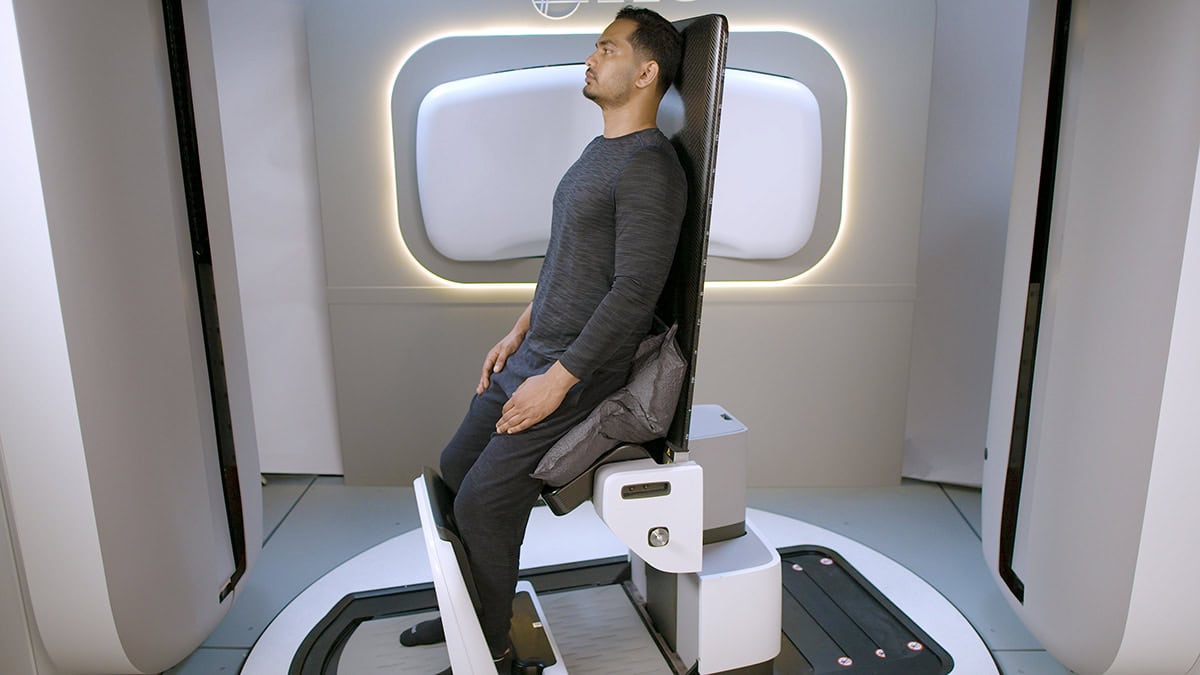 Since the beginning of radiation therapy, almost all treatments have been delivered with the patient lying on a table while the beam rotates around them. But a resurgence in upright patient positioning is changing that paradigm. Novel radiation accelerators such as proton therapy, VHEE, and FLASH therapy are often too large to rotate around the patient, making access limited. By instead rotating the patient, these previously hard-to-access beams could now become mainstream in the future.