↩ Accueil

Vue lecture

Scientists in China celebrate the completion of the underground JUNO neutrino observatory

The $330m Jiangmen Underground Neutrino Observatory (JUNO) has released its first results following the completion of the huge underground facility in August.

JUNO is located in Kaiping City, Guangdong Province, in the south of the country around 150 km west of Hong Kong.

Construction of the facility began in 2015 and was set to be complete some five years later. Yet the project suffered from serious flooding, which delayed construction.

JUNO, which is expected to run for more than 30 years, aims to study the relationship between the three types of neutrino: electron, muon and tau. Although JUNO will be able to detect neutrinos produced by supernovae as well as those from Earth, the observatory will mainly measure the energy spectrum of electron antineutrinos released by the Yangjiang and Taishan nuclear power plants, which both lie 52.5 km away.

To do this, the facility has a 80 m high and 50 m diameter experimental hall located 700 m underground. Its main feature is a 35 m radius spherical neutrino detector, containing 20,000 tonnes of liquid scintillator. When an electron antineutrino occasionally bumps into a proton in the liquid, it triggers a reaction that results in two flashes of light that are detected by the 43,000 photomultiplier tubes that observe the scintillator.

On 18 November, a paper was submitted to the arXiv preprint server concluding that the detector’s key performance indicators fully meet or surpass design expectations.

New measurement 

Neutrinos oscillate from one flavour to another as they travel near the speed of light, rarely interacting with matter. This oscillation is a result of each flavour being a combination of three neutrino mass states.

Yet scientists do not know the absolute masses of the three neutrinos but can measure neutrino oscillation parameters, known as θ12, θ23 and θ13, as well as the square of the mass differences (Δm2) between two different types of neutrinos.

A second JUNO paper submitted on 18 November used data collected between 26 August and 2 November to measure the solar neutrino oscillation parameter θ12 and Δm221 with a factor of 1.6 better precision than previous experiments.

Those earlier results, which used solar neutrinos instead of reactor antineutrinos, showed a 1.5 “sigma” discrepancy with the Standard Model of particle physics. The new JUNO measurements confirmed this difference, dubbed the solar neutrino tension, but further data will be needed to prove or disprove the finding.

“Achieving such precision within only two months of operation shows that JUNO is performing exactly as designed,” says Yifang Wang from the Institute of High Energy Physics of the Chinese Academy of Sciences, who is JUNO project manager and spokesperson. “With this level of accuracy, JUNO will soon determine the neutrino mass ordering, test the three-flavour oscillation framework, and search for new physics beyond it.”

JUNO, which is an international collaboration of more than 700 scientists from 75 institutions across 17 countries including China, France, Germany, Italy, Russia, Thailand, and the US, is the second neutrino experiment in China, after the Daya Bay Reactor Neutrino Experiment. It successfully measured a key neutrino oscillation parameter called θ13 in 2012 before being closed down in 2020.

JUNO is also one of three next-generation neutrino experiments, the other two being the Hyper-Kamiokande in Japan and the Deep Underground Neutrino Experiment in the US. Both are expected to become operational later this decade.

The post Scientists in China celebrate the completion of the underground JUNO neutrino observatory appeared first on Physics World.

  •  

Gigabyte Z890 Aorus Elite X Ice Review

If you're considering a value-conscious Intel system and want a good-looking motherboard with all the trimmings for around $200, then Gigabyte has a gem here with great connectivity and cooling, especially if you're building a white PC.

  •  

Accelerator experiment sheds light on missing blazar radiation

New experiments at CERN by an international team have ruled out a potential source of intergalactic magnetic fields. The existence of such fields is invoked to explain why we do not observe secondary gamma rays originating from blazars.

Led by Charles Arrowsmith at the UK’s University of Oxford, the team suggests the absence of gamma rays could be the result of an unexplained phenomenon that took place in the early universe.

A blazar is an extraordinarily bright object with a supermassive black hole at its core. Some of the matter falling into the black hole is accelerated outwards in a pair of opposing jets, creating intense beams of radiation. If a blazar jet points towards Earth, we observe a bright source of light including high-energy teraelectronvolt gamma rays.

During their journey across intergalactic space, these gamma-ray photons will occasionally collide with the background starlight that permeates the universe. These collisions can create cascades of electrons and positrons that can then scatter off photons to create gamma rays in the gigaelectronvolt energy range. These gamma-rays should travel in the direction of the original jet, but this secondary radiation has never been detected.

Deflecting field

Magnetic fields could be the reason for this dearth, as Arrowsmith explains: “The electrons and positrons in the pair cascade would be deflected by an intergalactic magnetic field, so if this is strong enough, we could expect these pairs to be steered away from the line of sight to the blazar, along with the reprocessed gigaelectronvolt gamma rays.” It is not clear, however, that such fields exist – and if they do, what could have created them.

Another explanation for the missing gamma rays involves the extremely sparse plasma that permeates intergalactic space. The beam of electron–positron pairs could interact with this plasma, generating magnetic fields that separate the pairs. Over millions of years of travel, this process could lead to beam–plasma instabilities that reduce the beam’s ability to create gigaelectronvolt gamma rays that are focused on Earth.

Oxford’s Gianluca Gregori  explains, “We created an experimental platform at the HiRadMat facility at CERN to create electron–positron pairs and transport them through a metre-long ambient argon plasma, mimicking the interaction of pair cascades from blazars with the intergalactic medium”. Once the pairs had passed through the plasma, the team measured the degree to which they had been separated.

Tightly focused

Called Fireball, the experiment found that the beams remained far more tightly focused than expected. “When these laboratory results are scaled up to the astrophysical system, they confirm that beam–plasma instabilities are not strong enough to explain the absence of the gigaelectronvolt gamma rays from blazars,” Arrowsmith explains. Unless the pair beam is perfectly collimated, or composed of pairs with exactly equal energies, instabilities were actively suppressed in the plasma.

While the experiment suggests that an intergalactic magnetic field remains the best explanation for the lack of gamma rays, the mystery is far from solved. Gregori explains, “The early universe is believed to be extremely uniform – but magnetic fields require electric currents, which in turn need gradients and inhomogeneities in the primordial plasma.” As a result, confirming the existence of such a field could point to new physics beyond the Standard Model, which may have dominated in the early universe.

More information could come with opening of the Cherenkov Telescope Array Observatory. This will comprise ground-based gamma-ray detectors planned across facilities in Spain and Chile, which will vastly improve on the resolutions of current-generation detectors.

The research is described in PNAS.

The post Accelerator experiment sheds light on missing blazar radiation appeared first on Physics World.

  •  

Jeux vidéo : les maths sous toutes les surfaces

Les graphismes en 3D des jeux vidéo s’appuient sur la géométrie des surfaces. Algorithmes, fractales, plaquages, maillages, projections… À l’occasion de l’exposition « Sous la surface, les maths », découvrez comment ceux-ci aident à rendre les jeux plus immersifs.

  •  

Ask me anything: Jason Palmer – ‘Putting yourself in someone else’s shoes is a skill I employ every day’

What skills do you use every day in your job?

One thing I can say for sure that I got from working in academia is the ability to quickly read, summarize and internalize information from a bunch of sources. Journalism requires a lot of that. Being able to skim through papers – reading the abstract, reading the conclusion, picking the right bits from the middle and so on – that is a life skill.

In terms of other skills, I’m always considering who’s consuming what I’m doing rather than just thinking about how I’d like to say something. You have to think about how it’s going to be received – what’s the person on the street going to hear? Is this clear enough? If I were hearing this for the first time, would I understand it? Putting yourself in someone else’s shoes – be it the listener, reader or viewer – is a skill I employ every day.

What do you like best and least about your job?

The best thing is the variety. I ended up in this business and not in scientific research because of a desire for a greater breadth of experience. And boy, does this job have it. I get to talk to people around the world about what they’re up to, what they see, what it’s like, and how to understand it. And I think that makes me a much more informed person than I would be had I chosen to remain a scientist.

When I did research – and even when I was a science journalist – I thought “I don’t need to think about what’s going on in that part of the world so much because that’s not my area of expertise.” Now I have to, because I’m in this chair every day. I need to know about lots of stuff, and I like that feeling of being more informed.

I suppose what I like the least about my job is the relentlessness of it. It is a newsy time. It’s the flip side of being well informed, you’re forced to confront lots of bad things – the horrors that are going on in the world, the fact that in a lot of places the bad guys are winning.

What do you know today that you wish you knew when you were starting out in your career?

When I started in science journalism, I wasn’t a journalist – I was a scientist pretending to be one. So I was always trying to show off what I already knew as a sort of badge of legitimacy. I would call some professor on a topic that I wasn’t an expert in yet just to have a chat to get up to speed, and I would spend a bunch of time showing off, rabbiting on about what papers I’d read and what I knew, just to feel like I belonged in the room or on that call. And it’s a waste of time. You have to swallow your ego and embrace the idea that you may sound like you don’t know stuff even if you do. You might sound dumber, but that’s okay – you’ll learn more and faster, and you’ll probably annoy people less.

In journalism in particular, you don’t want to preload the question with all of the things that you already know because then the person you’re speaking to can fill in those blanks – and they’re probably going to talk about things you didn’t know you didn’t know, and take your conversation in a different direction.

It’s one of the interesting things about science in general. If you go into a situation with experts, and are open and comfortable about not knowing it all, you’re showing that you understand that nobody can know everything and that science is a learning process.

The post Ask me anything: Jason Palmer – ‘Putting yourself in someone else’s shoes is a skill I employ every day’ appeared first on Physics World.

  •  

iOS 27 sera le Snow Leopard de l'iPhone

Retour en 2007, Apple sort sa sixième version de Mac OS X, Leopard.
Très rapidement les critiques fusent, trop de nouveautés assorties de trop de bugs récurrents.
Pour faire face au mécontentement général, Apple décide de faire une pause dans les nouvelles fonctions et sort deux ans plus tard Snow Leopard. Cette version n'apporte que peu de nouveautés. En revanche l'accent a été mis sur la correction des bugs et l'amélioration des performances.

Aux dernières nouvelles la société s'apprêterait à faire de même avec iOS 27. La mise à jour n'apportera que peu de nouveautés visibles. En échange, tout sera retravaillé afin d'optimiser les performances et la stabilité. Le but est de créer un socle stable pour le futur.
Nous ne vous cachons pas que c'est une excellente nouvelle qui demande à être confirmée. C'est d'autant plus vrai qu'il y a aujourd'hui un facteur capital qui s'ajoute, la sécurité.

En 2009, il y avait peu de pirates réellement intéressés à réaliser des piratages de masse sur les Mac. Aujourd'hui, toutes les mises à jour iOS s'accompagnent de mises à jour de sécurité multiples car les failles peuvent rapporter des fortunes. Faire une pause dans les nouveautés et revoir le code en profondeur devrait donc aussi permettre de rendre iOS plus robuste face aux attaques incessantes.

  •  

Test – Echo Dot Max d’Amazon

Que vaut le tout nouveau Echo Dot Max d’Amazon ?

Il y a quelques semaines, Amazon a annoncé puis sorti sa nouvelle gamme d’appareils Echo. Aujourd’hui, nous découvrons ensemble l’Echo Dot Max.

Notre modèle du jour est d’ailleurs disponible en trois coloris : graphite (modèle que nous avons gentiment reçu), blanc et améthyste. Ils sont tous les trois disponibles au même prix, soit 109,99 € hors promotion.

Place au test !


Unboxing

Depuis quelques temps, la sobriété est au rendez-vous pour les emballages de produits signés Amazon, et on adore ça. Ici un retrouvera un bandeau bleu clair sur le haut du paquet où on retrouvera la mention Amazon sur l’avant, avec juste en dessous un visuel de l’appareil et son nom. Le tout est dans une boîte en carton recyclé et recyclable. À droite nous retrouverons à nouveau le nom du modèle et ses compatibilités.

À gauche, en plusieurs langues, nous découvrirons que notre Echo Dot max fonctionne à la fois avec Alexa et Alexa + et à l’arrière pour terminer, là aussi en plusieurs langues, on nous indiquera qu’il s’agit d’une enceinte connectée et Alexa, qui inclut un Echo Dot Max graphite et un adaptateur secteur. Bien sûr, on nous rappellera aussi que le Wi-Fi et l’application Amazon Alexa sont requis.

Echo Dot Max 2025 Amazon


Caractéristiques techniques

Dimensions 108,7 x 108,6 x 99,2 mm (l x H x P)
Poids 505,3 g
Le poids et la taille exacts peuvent varier selon le procédé de fabrication.
Bande passante audio 53 Hz-16 kHz (volume 6)
Dimensions du haut-parleur 1 tweeter 20 mm, 1 caisson de basses 63 mm
Canaux de lecture Audio mono bidirectionnel
Technologie de traitement du signal audio Audio haute définition sans perte, adaptation automatique à la pièce
Connectivité Wi-Fi Wi-Fi 6E 11a/b/g/n/ac/ax 1×1, technologie Bluetooth sans fil/Bluetooth Low Energy 5.3
Hub connecté intégré Zigbee + Matter + Thread Border Router
Connectivité Bluetooth Prise en charge du profil Advanced Audio Distribution Profile (A2DP) pour le streaming audio depuis votre appareil mobile vers Echo Dot Max ou depuis Echo Dot Max vers votre enceinte Bluetooth. Prise en charge du profil Audio/Video Remote Control Profile (AVRCP) pour le contrôle vocal des appareils mobiles connectés. Le contrôle vocal mains-libres n’est pas pris en charge pour les appareils Mac OS X. Les enceintes Bluetooth qui requièrent un code PIN ne sont pas prises en charge.
Processeur AZ3 avec accélérateur d’IA
Capteurs Capteur de température ambiante, capteur de lumière ambiante, détection de présence, accéléromètre (pour les gestes tactiles)
Système requis Echo Dot Max est prêt à être connecté à votre Wi-Fi. L’application Alexa est compatible avec les appareils Fire OS, Android et iOS (voir les systèmes d’exploitation pris en charge). Certaines Skills et certains services peuvent nécessiter un abonnement ou d’autres frais.
Configuration requise Amazon Wi-Fi simple setup permet aux clients de connecter en quelques étapes faciles des appareils connectés à leur réseau Wi-Fi. Wi-Fi simple setup est une autre façon pour Alexa de se perfectionner sans cesse.


Echo Dot Max 2025 Amazon


Fonctionnalités

  • Découvrez Echo Dot Max : conçu pour livrer un son riche qui emplit l’espace et s’adapte automatiquement à l’acoustique de votre pièce, cet appareil optimise la lecture de votre contenu audio. Il est également doté d’un hub connecté intégré, de la technologie Omnisense pour un environnement optimisé, ainsi que d’une puce AZ3 pour des performances de rapidité optimales.
  • De la musique à vos oreilles : cette enceinte connectée se fond parfaitement dans n’importe quel espace. Écoutez de la musique via vos services de streaming préférés tels qu’Amazon Music, Apple Music, Deezer, Spotify et bien plus, en profitant de basses profondes et d’une clarté améliorée. On en redemande !
  • Encore plus de possibilités grâce au jumelage : connectez des appareils Echo compatibles dans différentes pièces ou jumelez votre appareil à un deuxième Echo Dot Max afin de profiter d’un son encore plus riche. BIENTÔT DISPONIBLE : votre Echo Dot Max peut également être jumelé à des appareils Fire TV compatibles pour créer un système de home cinéma qui donne vie aux scènes.
  • Contrôlez votre maison connectée en toute simplicité : programmez des routines et jumelez et contrôlez des lumières, des serrures et des milliers d’appareils fonctionnant avec Alexa, sans avoir recours à un hub connecté séparé. Avec la technologie Omnisense, activez des routines grâce à la détection des mouvements ou de la température.
  • Faites-en plus avec Alexa : météo, rappels et bien plus … Alexa a la réponse.
  • Conçu pour protéger votre vie privée : Amazon n’a pas pour vocation de vendre vos informations personnelles à des tiers. Cet appareil est conçu avec de multiples éléments de contrôle de vos informations personnelles, dont un bouton Activer/désactiver les microphones.


Contenu

  • Echo Dot Max (modèle 2025),
  • adaptateur secteur (22 W),
  • guide de démarrage rapide

Echo Dot Max 2025 Amazon

Test 

Quand Amazon a dévoilé sa nouvelle gamme Echo 2025, impossible de ne pas remarquer le Dot Max, présenté comme la petite enceinte qui veut jouer dans la cour des grandes. Chez Vonguru, on aime bien quand les constructeurs se montrent ambitieux, alors on a posé l’appareil sur un bureau, branché le câble, réveillé Alexa, et observé ce que cette petite boule prometteuse avait vraiment dans le ventre.

Dès le déballage, l’Echo Dot Max surprend. On retrouve la forme sphérique qui a fait le succès de la gamme, mais Amazon a introduit un côté plat où se logent les boutons de volume, le contrôle du micro et la fameuse LED signature. Ce détail change tout : l’enceinte paraît moins gadget, plus objet high-tech assumé. Le tissu tressé enveloppe proprement la coque, l’ensemble est solide, dense, presque premium dans l’esprit. On a envie de la poser dans un salon, une chambre ou même un bureau sans se dire qu’on gâche sa déco.

Echo Dot Max 2025 Amazon

Mais ce n’est évidemment pas pour le design qu’on attendait ce modèle : c’est pour le son. Amazon promettait des basses jusqu’à trois fois plus profondes que sur un Echo Dot classique. Et effectivement, à la première écoute, on sent que l’enceinte vise un rendu nettement plus ample. Les basses se déploient avec un certain aplomb, donnant une vraie présence aux musiques chill, electro ou pop. Les médiums sont propres, les voix bien articulées, et les aigus montent sans agressivité. Alors oui, si l’on pousse le volume très haut, on peut sentir une petite saturation et noter que l’équilibre n’atteint pas le raffinement des très grosses enceintes du marché. Mais replacé dans son contexte — une mini enceinte connectée à un peu plus de 100 euros — le résultat est franchement bien. On peut remplir une pièce moyenne sans frustration, ce qui n’était pas toujours le cas des précédents modèles.

Côté intelligence, la puce AZ3 fait un travail remarquable. L’Echo Dot Max réagit plus vite, entend mieux, surtout en environnement bruyant. On peut parler depuis une autre pièce sans devoir hausser le ton, et Alexa capte l’instruction. Cela entraine cependant un problème si comme moi, vous disposez déjà d’autres Echo au sein de votre foyer. Ici, c’est toujours lui qui me répond alors que je parle plus souvent à mon Echo Show 15 présent dans la cuisine.

Les capteurs « Omnisense », intégrés pour rendre l’appareil plus « proactif », semblent apporter une logique plus fluide aux interactions, même si tout leur potentiel prendra son sens quand Alexa+ — la version boostée à l’IA — sera réellement disponible en France. Pour l’instant, l’attente reste de mise (et longue…), et c’est probablement le point le plus frustrant de ce produit : il donne envie d’un futur qui n’est pas encore totalement là.

Echo Dot Max 2025 Amazon

L’Echo Dot Max s’impose aussi comme un petit hub domotique solide, compatible Zigbee, Matter et Thread. Il peut piloter des ampoules, des prises ou des capteurs sans qu’on doive investir dans un pont supplémentaire. C’est pratique, simple et très accessible pour ceux qui veulent monter un petit écosystème connecté.

Bien sûr, l’appareil n’est pas exempt de limites. L’équilibre sonore peut manquer d’un soupçon de finesse sur certains morceaux, et ceux qui pensent “home studio” devront plutôt regarder du côté de l’Echo Studio.  En revanche, si l’on s’en tient à son usage principal — une enclave sonore sympa avec un assistant vocal réactif — l’Echo Dot Max coche largement les bonnes cases. Pour moi, dans un bureau ou dans une chambre, c’est l’emplacement idéal.

Conclusion

Pour conclure, cette enceinte donne clairement le sentiment d’être une évolution logique de ce qu’un Echo Dot doit être en 2025 : plus ambitieuse, plus puissante, mieux pensée, et surtout tournée vers l’avenir. Elle ne révolutionne pas le son, mais elle améliore suffisamment l’expérience pour la rendre immédiatement agréable au quotidien. Si vous cherchez une enceinte compacte qui fait bien plus que diffuser de la musique, et qui s’intègre parfaitement à un foyer déjà un peu connecté, l’Echo Dot Max mérite largement sa place dans votre intérieur.

Cependant, l’arrivée d’Alexa + se fait de plus en plus attendre et on a hâte de voir si tout le potentiel de cette nouveauté sera bel et bien utilisé. Affaire à suivre !

Pour rappel, notre modèle du jour est disponible en trois coloris : graphite (modèle que nous avons gentiment reçu), blanc et améthyste. Ils sont tous les trois disponibles au même prix, soit 109,99 € hors promotion.

Test – Echo Dot Max d’Amazon a lire sur Vonguru.

  •  

Pourquoi je n’achèterai pas le Leica Q3 Monochrom même s’il est génial

Cette semaine, Leica vient de sortir son Leica Q3 Monochrom, l’équivalent du Leica Q3 « normal », 28 mm et testé ici, mais qui ne photographie qu’en noir et blanc. Il a tout pour me plaire, ce magnifique boîtier. Cela dit, un appareil qui ne photographie qu’en noir et blanc? Et plus cher encore (mais oui c’est possible!) que le Leica Q3 qui, lui, photographie en couleur, mais aussi en noir et blanc? Non, mais ça ... Continuer la lecture
  •  

Test de Silent Hill f | De l’audace, mais des limaces dans la salade

Le retour de la série Silent Hill f, et de Konami, était plutôt inespéré. Après des années de silence, la saga nous revient plus forte que jamais. Et si nous avons déjà pu tâter le remake de Silent Hill 2, nous vous proposons ce test de Silent Hill f qui fait sortir la saga de sa ville natale. Point de Silent Hill ici, mais une toute nouvelle bourgade, pas plus rassurante. Le titre vaut-il le coup ? Verdict dans les lignes suivantes !

Silent Hill f | De quoi ça parle ?

  • Survival-Horror dans lequel vous incarnez Hinako Shimizu. Les faits se déroulent dans la ville de Ebisugaoka, au Japon des années 1960. La ville est rapidement englouti par un terrible brouillard et des monstres effrayants…
  • Disponible dès maintenant sur PC, PS5 et Xbox Series X|S
  • Prix de lancement : 56€ sur PS5 via Amazon.fr
  • Durée de vie approximative : entre 13 et 15 heures pour un premier run
  • Testé sur PC, via une version Steam achetée par nos soins
  • Configuration de test : CPU i9-9900KF, 32Go RAM, GPU RTX 4070

Les gros points forts de Silent Hill f

  • Une ambiance du tonnerre ! Tout est vraiment soigné et somptueux
  • Un vrai jeu typé « urbex » à de nombreuses reprises, dans cette ville bouffée par la malédiction
  • Des personnages charismatiques
  • Ebisugaoka est une ville très variée au niveau des environnements traversés
  • On ne regrette à aucun moment la ville de Silent Hill. Le changement est génial
  • Des boss vraiment très chouette à affronter
  • Un système de combat qui a fait « polémique » pour rien : il est très bon !
  • Des passages en monde alternatif, comme le veut la série
  • Une OST et des doublages en anglais réussis
  • L’univers du jeu est excellent, tout simplement
  • Pas d’armes à feu. Cela rappelle la série Project Zero / Fatal Frame
  • Plusieurs fins disponibles : encourage le multi-run

Les points faibles de Silent Hill f

  • Le scénario est vraiment cryptique : plus on avance, moins on comprend les choses
  • Les phases dans le monde alternatif sont vraiment imbuvables en termes de compréhension
  • Les énigmes sont ratées. Illogiques, redondantes, et surtout absolument pas fun à résoudre
  • Trop de phases de combat avec des ennemis qui mettent du temps à clamser
  • Les armes cassables, c’est un gros non
  • Certains niveaux qui trainent beaucoup trop en longueur

Vous aimerez Silent Hill f, si :

  • Vous aimez les Survival-Horror à la Project Zero
  • Vous faites l’impasse sur les énigmes ratées et le scénario moyen
  • Vous le trouvez à 30 / 40€ maximum

Verdict : 14/20

Cela me fait un peu de peine de ne mettre « que » la note de 14/20 à ce test de Silent Hill f, mais ses erreurs lui coûtent cher. Et elles pèsent surtout finalement assez lourd dans la balance. Somptueux aussi bien artistiquement que techniquement, le titre de Konami en met plein les yeux. Mais il déçoit énormément sur le plan de ses énigmes, vraiment mauvaises. Ajoutez à cela des phases de combat trop longues, des niveaux trop longs et un scénario alambiqué pour pas grand chose et vous obtiendrez une expérience de jeu que l’on peut qualifier de bonne, mais non sans défauts.

Je retiendrai surtout la qualité d’immersion de ce Silent Hill f. Avec des décors grandioses, des combats de boss réussis et un aspect exploration urbaine passionnant, j’espère que ce titre aura droit à une suite qui corrigera les vilains défauts de jeunesse de ce premier tome ! Il y a clairement un immense potentiel !

L’article Test de Silent Hill f | De l’audace, mais des limaces dans la salade est apparu en premier sur PLAYERONE.TV.

  •  

XMG 14 Evo (E25) Review - Small but powerful and feature-rich

The XMG 14 Evo (Е25) can be described as a compact and light workstation if you configure it with more RAM and a Ryzen 9 CPU. The cooling is capable, and it allows impressively high clocks even in 3D rendering. The perfect upgradability and the surprisingly solid port selection make this compact laptop easy to recommend.

  •  

Sympathetic cooling gives antihydrogen experiment a boost

Physicists working on the Antihydrogen Laser Physics Apparatus (ALPHA) experiment at CERN have trapped and accumulated 15,000 antihydrogen atoms in less than 7 h. This accumulation rate is more than 20 times the previous record. Large ensembles of antihydrogen could be used to search for tiny, unexpected differences between matter and antimatter – which if discovered could point to physics beyond the Standard Model.

According to the Standard Model every particle has an antimatter counterpart – or antiparticle. It also says that roughly equal amounts of matter and antimatter were created in the Big Bang. But, today there is much more matter than antimatter in the visible universe, and the reason for this “baryon asymmetry” is one of the most important mysteries of physics.

The Standard Model predicts the properties of antiparticles. An antiproton, for example, has the same mass as a proton and the opposite charge. The Standard Model also predicts how antiparticles interact with matter and antimatter. If physicists could find discrepancies between the measured and predicted properties of antimatter, it could help explain the baryon asymmetry and point to other new physics beyond the Standard Model.

Powerful probe

Just as a hydrogen atom comprises a proton bound to an electron, an antihydrogen antiatom comprises an antiproton bound to an antielectron (positron). Antihydrogen offers physicists several powerful ways to probe antimatter at a fundamental level. Trapped antiatoms can be released in freefall to determine if they respond to gravity in the same way as atoms. Spectroscopy can be used to make precise measurements of how the electromagnetic force binds the antiproton and positron in antihydrogen with the aim of finding differences compared to hydrogen.

So far, antihydrogen’s gravitational and electromagnetic properties appear to be identical to hydrogen. However, these experiments were done using small numbers of antiatoms, and having access to much larger ensembles would improve the precision of such measurements and could reveal tiny discrepancies. However, creating and storing antihydrogen is very difficult.

Today, antihydrogen can only be made in significant quantities at CERN in Switzerland. There, a beam of protons is fired at a solid target, creating antiprotons that are then cooled and stored using electromagnetic fields. Meanwhile, positrons are gathered from the decay of radioactive nuclei and cooled and stored using electromagnetic fields. These antiprotons and positrons are then combined in a special electromagnetic trap to create antihydrogen.

This process works best when the antiprotons and positrons have very low kinetic energies (temperatures) when combined. If the energy is too high, many antiatoms will be escape the trap. So, it is crucial that the positrons and antiprotons to be as cold as possible.

Sympathetic cooling

Recently, ALPHA physicists have used a technique called sympathetic cooling on positrons, and in a new paper they describe their success.  Sympathetic cooling has been used for several decades to cool atoms and ions. It originally involved mixing a hard-to-cool atomic species with atoms that are relatively easy to cool using lasers. Energy is transferred between the two species via the electromagnetic interaction, which chills the hard-to-cool atoms.

The ALPHA team used beryllium ions to sympathetically cool positrons to 10 K, which is five degrees colder than previously achieved using other techniques. These cold positrons boosted the efficiency of the creation and trapping of antihydrogen, allowing the team to accumulate 15,000 antihydrogen atoms in less than 7 h. This is more than a 20-fold improvement over their previous record of accumulating 2000 antiatoms in 24 h.

Science fiction

“These numbers would have been considered science fiction 10 years ago,” says ALPHA spokesperson Jeffrey Hangst, who is a Denmark’s Aarhus University.

Team member Maria Gonçalves, a PhD student at the UK’s Swansea University, says, “This result was the culmination of many years of hard work. The first successful attempt instantly improved the previous method by a factor of two, giving us 36 antihydrogen atoms”.

The effort was led by Niels Madsen of the UK’s Swansea University. He enthuses, “It’s more than a decade since I first realized that this was the way forward, so it’s incredibly gratifying to see the spectacular outcome that will lead to many new exciting measurements on antihydrogen”.

The cooling technique is described in Nature Communications.

The post Sympathetic cooling gives antihydrogen experiment a boost appeared first on Physics World.

  •  

Chieftec The Cube Review

Chieftec's The Cube is the third offering of its cuboid line-up, which first saw the light of day nearly a decade ago. While the first two were aimed at gamers and professionals, The Cube mimics the design of a speaker, to fit into a living room or audiophile setups. But will a case with this kind of history still live up to the needs and requirements of the modern user?

  •  

Sciences : dans la forge des mots nouveaux

Planète vagabonde, gaz à effet de serre, base de données, infox, IA générative… Le Journal officiel publie régulièrement des listes de nouveaux termes, notamment scientifiques et techniques, avec leur définition. Mais quelle logique se cache derrière leur sélection ?

  •  

Plasma bursts from young stars could shed light on the early life of the Sun

The Sun frequently ejects high-energy bursts of plasma that then travel through interplanetary space. These so-called coronal mass ejections (CMEs) are accompanied by strong magnetic fields, which, when they interact with the Earth’s atmosphere, can trigger solar storms that can severely damage satellite systems and power grids.

In the early days of the solar system, the Sun was far more active than it is today and ejected much bigger CMEs. These might have been energetic enough to affect our planet’s atmosphere and therefore influence how life emerged and evolved on Earth, according to some researchers.

Since it is impossible to study the early Sun, astronomers use proxies – that is, stars that resemble it. These “exo-suns” are young G-, K- and M-type stars and are far more active than our Sun is today. They frequently produce CMEs with energies far larger than the most energetic solar flares recorded in recent times, which might not only affect their planets’ atmospheres, but may also affect the chemistry on these planets.

Until now, direct observational evidence for eruptive CME-like phenomena on young solar analogues has been limited. This is because clear signatures of stellar eruptions are often masked by the brightness of their host stars and flares on these. Measurements of Doppler shifts in optical lines have allowed astronomers to detect a few possible stellar eruptions associated with giant superflares on a young solar analogue, but these detections have been limited to single-wavelength data at “low temperatures” of around 104 K. Studies at higher temperatures have been few and far between. And although scientists have tried out promising techniques, such as X-ray and UV dimming, to advance their understanding of these “cool” stars, few simultaneous multi-wavelength observations have been made.

A large Carrington-class flare from EK Draconis

On 29 March 2024, astronomers at Kyoto University in Japan detected a large Carrington-class flare – or superflare – in the far-ultraviolet from EK Draconis, a G-type star located approximately 112 light-years away from the Sun. Thanks to simultaneous observations in the ultraviolet and optical ranges of the electromagnetic spectrum, they say they have now been able to obtain the first direct evidence for a multi-temperature CME from this young solar analogue (which is around 50 to 125 million years old and has a radius similar to the Sun).

The researchers’ campaign spanned four consecutive nights from 29 March to 1 April 2024. They made their ultraviolet observations with the Hubble Space Telescope and the Transiting Exoplanet Survey Satellite (TESS) and performed optical monitoring using three ground-based telescopes in Japan, Korea and the US.

They found that the far-ultraviolet and optical lines were Doppler shifted during and just before the superflare, with the ultraviolet observations showing blueshifted emission indicative of hot plasma. About 10 minutes later, the optical telescopes observed blueshifted absorption in the hydrogen Hα line, which indicates cooler gases. According to the team’s calculations, the hot plasma had a temperature of 100 000 K and was ejected at speeds of 300–550 km/s, while the “cooler” gas (with a temperature of 10 000 K) was ejected at 70 km/s.

“These findings imply that it is the hot plasma rather than the cool plasma that carries kinetic energy into planetary space,” explains study leader Kosuke Namekata. “The existence of this plasma suggests that such CMEs from our Sun in the past, if frequent and strong, could have driven shocks and energetic particles capable of eroding or chemically altering the atmosphere of the early Earth and the other planets in our solar system.”

“The discovery,” he tells Physics World, “provides the first observational link between solar and stellar eruptions, bridging stellar astrophysics, solar physics and planetary science.”

Looking forward, the researchers, who report their work in Nature Astronomy, now plan to conduct similar, multiwavelength campaigns on other young solar analogues to determine how frequently such eruptions occur and how they vary from star to star.

“In the near future, next-generation ultraviolet space telescopes such as JAXA’s LAPYUTA and NASA’s ESCAPADE, coordinated with ground-based facilities, will allow us to trace these events more systematically and understand their cumulative impact on planetary atmospheres,” says Namekata.

The post Plasma bursts from young stars could shed light on the early life of the Sun appeared first on Physics World.

  •  

Test – Manette Xbox Turtle Beach Rematch Advanced Blue Kitsune

Que vaut la manette pour Xbox Turtle Beach Rematch Advanced Blue Kitsune ?

À force de voir débarquer des manettes à chaque saison comme on voit revenir les citrouilles en automne, on finit par croire qu’il n’y a plus grand-chose à inventer. Cependant, Turtle Beach arrive avec une proposition qui, sans révolutionner la galaxie du gaming, parvient tout de même à imposer une vraie personnalité. La Turtle Beach Rematch Advanced Blue Kitsune, sous licence officielle Xbox, n’est ni une manette premium hors de prix, ni un clone générique sans âme. C’est un entre-deux assumé : un accessoire filaire simple, robuste, efficace… mais qui ne se prive pas d’un petit coup de fantaisie avec son design phosphorescent qui s’illumine dans l’obscurité.

Nous avons passé plusieurs jours avec elle entre les mains sur PC, pour voir si cette Blue Kitsune méritait de s’inviter dans votre setup. 

Vous la retrouverez au prix de 39,99 €. Place au test !

Unboxing

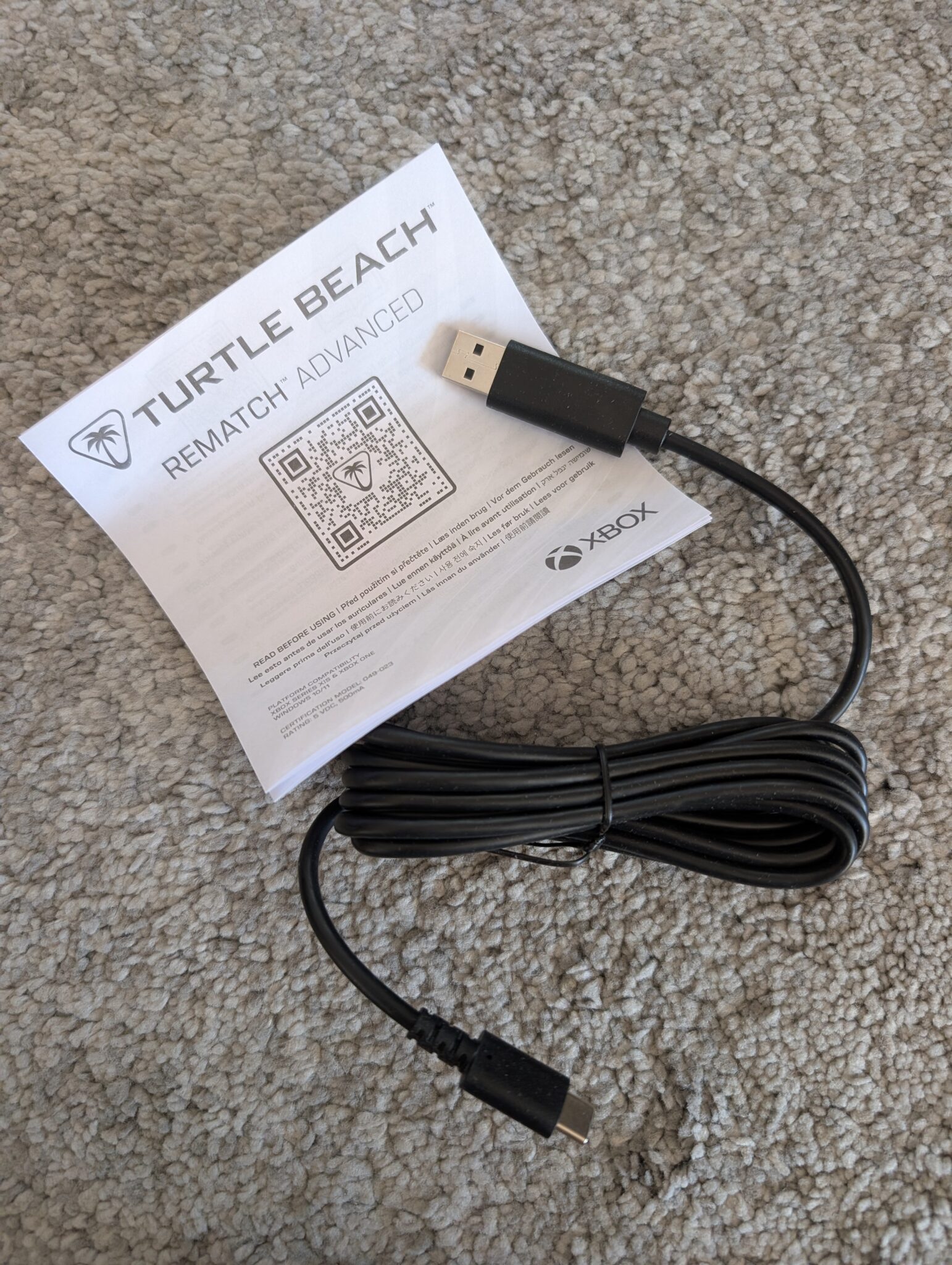
Commençons notre test par notre traditionnelle partie unboxing, ou nous retrouverons sur l’avant de la boîte un visuel de la manette, turquoise sur fond bleu, avec la mention de son côté brillant et phosphorescent.  Nous retrouverons, le tout en anglais, quelques unes de ses principaux atouts, sans oublier la mention « conçue pour Xbox », ce qui rassure ainsi tous les joueurs. À gauche, on nous rappellera le nom du produit avec un nouveau visuel de la mnatte, cette fois toute sombre avec ses dessins en surbrillance (superbe) et à droite à nouveau quelques fonctionnalités, fonctionnalités que nous listerons peu après.

En dessous, nous aurons et ce en plusieurs langues, le détail du contenu de la boîte et pour finir, à l’arrière, deux nouveaux visuels avec le reste des informations techniques, le tout en 6 langues.

Xbox Turtle Beach Rematch Advanced Blue Kitsune


Fonctionnalités et caractéristiques techniques

  • Conception légendaire – Inspirée du folklore japonais, la conception Blue Kitsune arbore des touches éclatantes et des détails audacieux qui donnent vie à l’esprit du renard mythique.
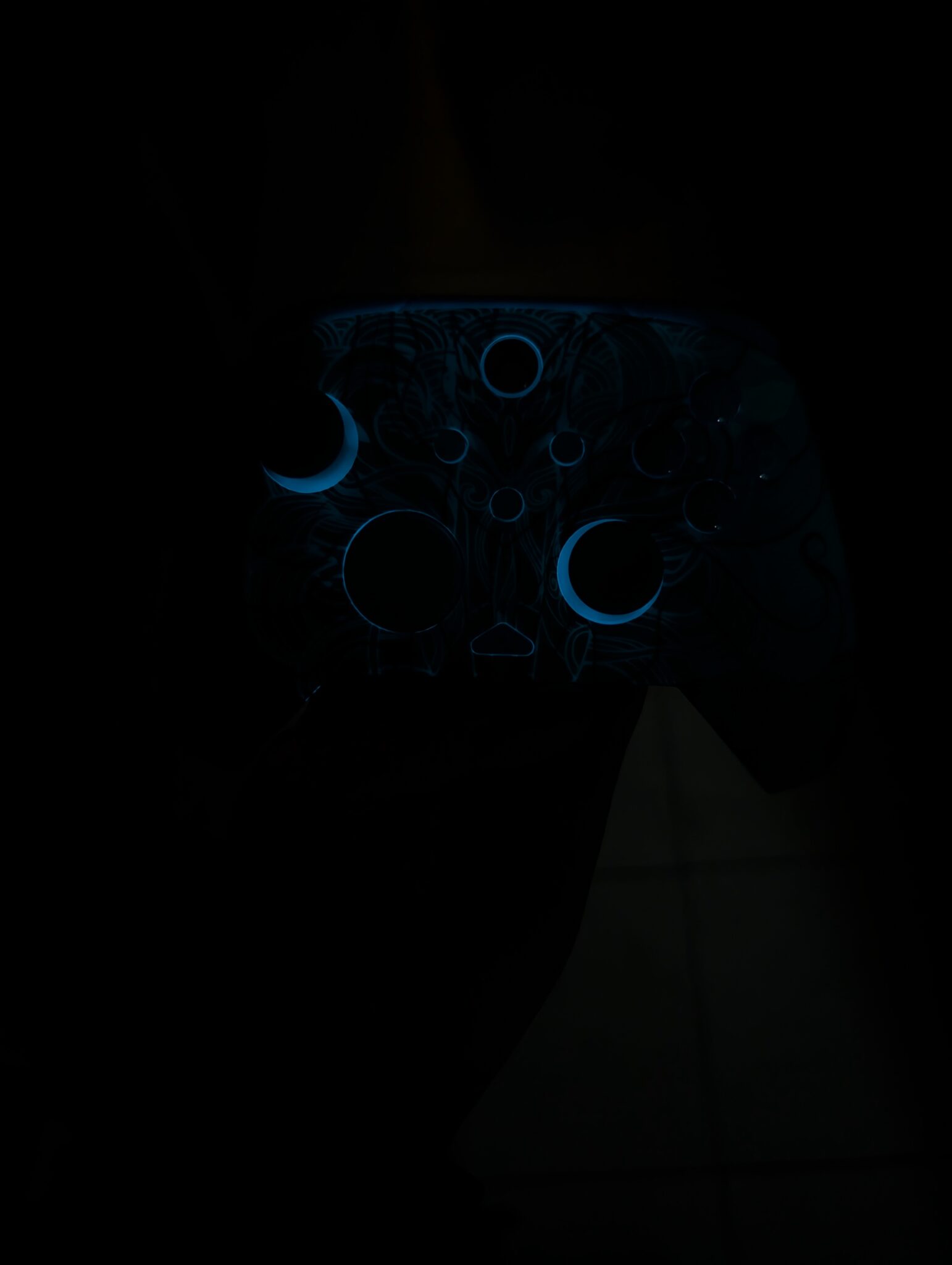
  • Éclairez votre chemin – La manette Blue Kitsune s’illumine instantanément lorsque vous la branchez. Pas d’exposition à la lumière nécessaire. L’éclat bleu vibrant apporte un style audacieux et une atmosphère particulière à votre configuration.
  • Gameplay personnalisable – Les gâchettes à 2 crans vous permettent d’ajuster la profondeur pour améliorer l’exactitude, la précision et le temps de réaction, tandis que les deux moteurs de vibration et les gâchettes à impulsion offrent un contrôle réactif, pour une expérience de gaming immersive.
  • Expérience immersive – Les deux moteurs de vibration et les gâchettes à impulsion offrent un retour dynamique, pour un réalisme plus poussé à chaque action. Ressentez chaque coup, accident et explosion avec précision, pour une meilleure immersion dans le gameplay.
  • Commandes audio brevetées – Ajustez facilement l’audio à la volée grâce aux commandes sur la croix directionnelle. Vous pouvez ainsi régler la balance sonore jeu/chat et le volume principal, et vous bénéficiez d’un bouton dédié pour couper le microphone.

Contenu

  • Manette Rematch Advanced
  • Câble USB-C 2,4m
  • Insertion à démarrage rapide

Xbox Turtle Beach Rematch Advanced Blue Kitsune


Test 

La première chose qui frappe, c’est évidemment ce bleu vif rehaussé d’un motif Kitsune stylisé, presque « cosmic fantasy », qui prend toute sa dimension lorsque la lumière baisse. La manette devient alors une sorte de totem gamer phosphorescent, une trouvaille qui évoque un mélange entre culture pop japonaise et esthétique cyber. On aime ou on n’aime pas, mais au moins, elle assume. Et dans un marché saturé de manettes noires, blanches ou « urban camo », ça change. La prise en main, elle, reste familière : on est sur une ergonomie très proche de la manette Xbox officielle, ce qui permet de s’adapter instantanément. Le châssis est plus léger que celui d’une manette sans fil, mais l’équilibre reste bon, sans effet « creux ». Après, ça, c’est aussi une question d’habitude et de goût.

Côté sensation en jeu, on peut dire que le tout est fiable, réactive et sans chichi inutile. La Rematch Advanced ne joue pas la carte du gadget à outrance : elle mise sur des fondamentaux solides.

Les sticks – Précis, stables, avec juste assez de résistance pour éviter les dérives incontrôlées.

Xbox Turtle Beach Rematch Advanced Blue Kitsune

Les gâchettes – Un point fort : elles offrent un retour bien calibré, ni trop spongieux ni trop secs. Sur des jeux de tir ou de conduite, la différence est notable par rapport à certaines manettes filaires d’entrée de gamme souvent trop molles.

Les boutons programmables – Deux boutons à l’arrière, facilement accessibles mais assez bien intégrés pour ne pas être activés par accident — à condition de ne pas jouer avec des mains de bûcheron. Idéal pour remplacer un saut, une glissade ou un rechargement rapide, selon votre style de jeu.

Une latence quasi inexistante grâce au câble – C’est l’avantage indiscutable des manettes filaires : zéro micro-coupure, zéro batterie qui agonise, zéro latence perceptible. Le câble tressé de 2,5 mètres laisse largement de quoi jouer sans se sentir attaché au meuble TV comme un chien à sa niche.

Xbox Turtle Beach Rematch Advanced Blue Kitsune

On connaît Turtle Beach pour ses casques, pas pour ses manettes. Et c’est précisément pour ça que la présence de commandes audio directement intégrées fait toute la différence.

Il suffit de brancher un casque en jack pour profiter :

  • du réglage du volume depuis la manette

  • de la gestion du mix jeu/chat

  • et surtout du mode Superhuman Hearing, la signature maison, qui amplifie certains sons clés (bruits de pas, rechargements ennemis…).

Testée sur Xbox One et PC, la manette a parfaitement fonctionné partout. Sur PC, aucun logiciel obligatoire, aucun driver exotique : on branche, ça marche. Le poids contenu est agréable sur la durée, même après de longues sessions. Le grip est plutôt correct, même si on aurait apprécié des surfaces légèrement plus texturées, surtout sur les poignées. Pour finir, l’effet glow-in-the-dark n’apporte rien à votre K/D ratio. Rien à votre performance non plus. Et pourtant, on a aimé. Le rendu est propre, visible sans être agressif, et donne un cachet vraiment atypique à la manette. Dans une pièce sombre, elle devient une petite sculpture lumineuse. Ce n’est pas indispensable, mais c’est fun — et parfois, c’est largement suffisant.

Xbox Turtle Beach Rematch Advanced Blue Kitsune

Conclusion 

La Turtle Beach Rematch Advanced Blue Kitsune est une bonne surprise : un produit pensé avec sérieux, mais qui ne renonce pas à se démarquer. Entre son ergonomie maîtrisée, ses boutons arrière programmables, ses commandes audio intégrées et son style phosphorescent totalement assumé, elle propose une expérience plus riche que beaucoup de manettes filaires dans la même gamme de prix.

Idéale comme manette principale pour les joueurs qui préfèrent la fiabilité du filaire, ou comme manette secondaire stylée pour le canapé du salon.

Turtle Beach signe ici un accessoire cohérent, fun, efficace — et qui n’essaie pas de jouer dans la cour des manettes premium à 150 €. Un bon rapport qualité/fonctionnalités pour les joueurs qui veulent autre chose que la manette Xbox standard, sans se ruiner.

Vous la retrouverez au prix de 39,99 €.

Test – Manette Xbox Turtle Beach Rematch Advanced Blue Kitsune a lire sur Vonguru.

  •  

MLX sous macOS 26.2 va accélérer les IA de type LLM génératif sur M5 ?

Je l'ai vu passer partout, voilà les explications techniques (en anglais).

En bref, non, pas pour un usage en chatbot, car si le M5 va 25% plus vite que le M4, l'accélération énorme (jusqu'à 4 fois plus rapide) promise n'est que pour l'ingestion des Tokens du Prompt (l'entrée donc), pas pour le traitement subséquent.

Avec mon prompt maintenant célèbre "Que faire un week-end de vacances à Limoges?" il n'y aura aucune accélération visible, hors les meilleures perfs du M5 face au M4, grâce à sa meilleure bande-passante mémoire. Mais pas nécessairement un meilleur week-end !

Donc en général, non, MLX sous macOS 26.2 n'accélèrera pas grand chose...


En ce moment, profitez du Black Friday : soutenez MacBidouille et partagez vos trouvailles

  •  

APNX V2 Review

The V2 is the first case from the brand that really feels like APNX is coming into its own in terms of design and functionality. Equipped with three glass panes and sporting four 140 mm fans and a controller, it already checks off most boxes. But the unique interior layout is the star of the show. All this at a price point that seems too good to pass up.

  •  

Flattened halo of dark matter could explain high-energy ‘glow’ at Milky Way’s heart

Astronomers have long puzzled over the cause of a mysterious “glow” of very high energy gamma radiation emanating from the centre of our galaxy. One possibility is that dark matter – the unknown substance thought to make up more than 25% of the universe’s mass – might be involved. Now, a team led by researchers at Germany’s Leibniz Institute for Astrophysics Potsdam (AIP) says that a flattened rather than spherical distribution of dark matter could account for the glow’s properties, bringing us a step closer to solving the mystery.

Dark matter is believed to be responsible for holding galaxies together. However, since it does not interact with light or other electromagnetic radiation, it can only be detected through its gravitational effects. Hence, while astrophysical and cosmological evidence has confirmed its presence, its true nature remains one of the greatest mysteries in modern physics.

“It’s extremely consequential and we’re desperately thinking all the time of ideas as to how we could detect it,” says Joseph Silk, an astronomer at Johns Hopkins University in the US and the Institut d’Astrophysique de Paris and Sorbonne University in France who co-led this research together with the AIP’s Moorits Mihkel Muru. “Gamma rays, and specifically the excess light we’re observing at the centre of our galaxy, could be our first clue.”

Models might be too simple

The problem, Muru explains, is that the way scientists have usually modelled dark matter to account for the excess gamma-ray radiation in astronomical observations was highly simplified. “This, of course, made the calculations easier, but simplifications always fuzzy the details,” he says. “We showed that in this case, the details are important: we can’t model dark matter as a perfectly symmetrical cloud and instead have to take into account the asymmetry of the cloud.”

Muru adds that the team’s findings, which are detailed in Phys. Rev. Lett., provide a boost to the “dark matter annihilation” explanation of the excess radiation. According to the standard model of cosmology, all galaxies – including our own Milky Way – are nested inside huge haloes of dark matter. The density of this dark matter is highest at the centre, and while it primarily interacts through gravity, some models suggest that it could be made of massive, neutral elementary particles that are their own antimatter counterparts. In these dense regions, therefore, such dark matter species could be mutually annihilating, producing substantial amounts of radiation.

Pierre Salati, an emeritus professor at the Université Savoie Mont Blanc, France, who was not involved in this work, says that in these models, annihilation plays a crucial role in generating a dark matter component with an abundance that agrees with cosmological observations. “Big Bang nucleosynthesis sets stringent bounds on these models as a result of the overall concordance between the predicted elemental abundances and measurements, although most models do survive,” Salati says. “One of the most exciting aspects of such explanations is that dark matter species might be detected through the rare antimatter particles – antiprotons, positrons and anti-deuterons – that they produce as they currently annihilate inside galactic halos.”

Silvia Manconi of the Laboratoire de Physique Théorique et Hautes Energies (LPTHE), France, who was also not involved in the study, describes it as “interesting and stimulating”. However, she cautions that – as is often the case in science – reality is probably more complex than even advanced simulations can capture. “This is not the first time that galaxy simulations have been used to study the implications of the excess and found non-spherical shapes,” she says, though she adds that the simulations in the new work offer “significant improvements” in terms of their spatial resolution.

Manconi also notes that the study does not demonstrate how the proposed distribution of dark matter would appear in data from the Fermi Gamma-ray Space Telescope’s Large Area Telescope (LAT), or how it would differ quantitatively from observations of a distribution of old stars. Forthcoming observations with radio telescopes such as MeerKat and FAST, she adds, may soon identify pulsars in this region of the galaxy, shedding further light on other possible contributions to the excess of gamma rays.

New telescopes could help settle the question

Muru acknowledges that better modelling and observations are still needed to rule out other possible hypotheses. “Studying dark matter is very difficult, because it doesn’t emit or block light, and despite decades of searching, no experiment has yet detected dark matter particles directly,” he tells Physics World. “A confirmation that this observed excess radiation is caused by dark matter annihilation through gamma rays would be a big leap forward.”

New gamma-ray telescopes with higher resolution, such as the Cherenkov Telescope Array, could help settle this question, he says. If these telescopes, which are currently under construction, fail to find star-like sources for the glow and only detect diffuse radiation, that would strengthen the alternative dark matter annihilation explanation.

Muru adds that a “smoking gun” for dark matter would be a signal that matches current theoretical predictions precisely. In the meantime, he and his colleagues plan to work on predicting where dark matter should be found in several of the dwarf galaxies that circle the Milky Way.

“It’s possible we will see the new data and confirm one theory over the other,” Silk says. “Or maybe we’ll find nothing, in which case it’ll be an even greater mystery to resolve.”

The post Flattened halo of dark matter could explain high-energy ‘glow’ at Milky Way’s heart appeared first on Physics World.

  •  

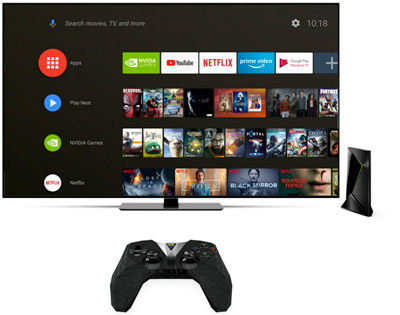
NVIDIA rend la SHIELD TV plus accessible aux personnes handicapées

Les mises à jour logicielles des consoles de jeu et lecteurs multimédia NVIDIA SHIELD TV se font désormais rares mais ont le mérite de se poursuivre. Le dernier firmware SHIELD Experience 9.2.1 est en effet sorti au printemps dernier pour offrir le streaming de jeux en 1080p à 120 FPS depuis le serv...

  •  

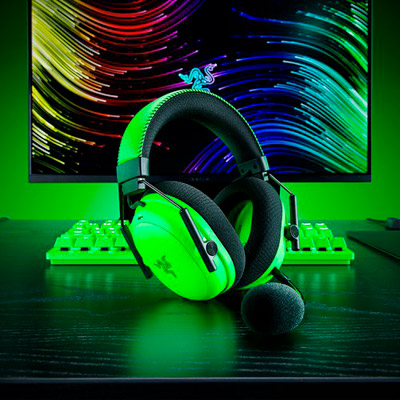
Le casque audio Razer BlackShark V3 Pro compatible Nintendo Switch 2

Razer proposait début septembre 2025 plusieurs mises à jour logicielles pour certains casques audio des gammes Barracuda, BlackShark et Kraken afin de leur ajouter la compatibilité avec la console de jeu Nintendo Switch 2. Quelques semaines plus tard, ce fut au tour du casque BlackShark V2 Pro (m...

  •  

Test de Tormented Souls 2 | Le Resident Evil rétro qu’il vous faut !

Si, comme nous, vous avez particulièrement adoré l’époque de l’ascension des Survival-Horror, nous vous conseillons plus que chaudement de lire ce test de Tormented Souls 2. Ode à l’ère de la 3D précalculée et des énigmes, le nouvel opus de Dual Effect. Tout petit studio chilien fondé en 2019, il signe avec cette suite une belle expérience néo-rétro que nous invitons à découvrir plus en détails dans les lignes suivantes.

Test de Tormented Souls 2 | Ce qu’il faut savoir

  • Jeu d’horreur en vue à la 3ème personne. Vous incarnez Caroline, qui accompagne sa sœur malade dans une bourgade reculée du sud du Chili. Vous allez rapidement vous retrouver seul dans Villa Hess, ville quasi totalement désertée de ses âmes…
  • Disponible dès maintenant sur PC, PS5 et Xbox Series X|S
  • Prix de lancement : 30€
  • Durée de vie : Entre 25 et 30 heures en mode normal pour un premier run
  • Testé sur PC, via une clé Steam offerte par l’éditeur
  • Configuration du test : i9-9900KF, 32GO RAM, SSD, RTX 4070

Les gros points forts de Tormented Souls 2

  • Un Survival-Horror à l’ancienne comme on les adorait à l’époque de Resident Evil, Silent Hill, Dino Crisis, Galerians et compagnie !
  • Graphiquement, c’est vraiment très souvent magnifique
  • Les angles de vues et de caméra sont toujours bien choisis
  • Des énigmes faciles, moyennes, difficiles qui sont toujours bien dosées, et surtout très bien documentées. En cherchant bien, on s’en sort toujours
  • Un équilibre parfait entre exploration, énigmes, combats et aventure
  • L’histoire est vraiment passionnante. Racontée aussi bien en scènes cinématiques qu’en notes à trouver un peu partout. C’est très complet !
  • Une palanquée d’armes à trouver qui offre un inventaire vraiment complet et dévastateur
  • Les combats de boss sont très bien faits, avec des points faibles à trouver pour chacun
  • La difficulté globale est bien dosée en mode normal. Vous pouvez également avoir droit à des sauvegardes automatiques en mode facile
  • Plusieurs fins. Pour avoir la meilleure, il faut vraiment se creuser les méninges et avoir le sens de l’observation !
  • Une durée de vie exceptionnelle pour un jeu du genre ! Et sans aucune lassitude
  • Les environnements sont très variés : couvent, bunker, labo
  • Des inspirations des cadors du genre des années 90 / début 2000 dans tous les sens
  • Pas énormément d’aller-retours, c’est tant mieux
  • Des ennemis qui vont flipper ! Moi qui ne sursaute quasi jamais, Tormented Souls 2 a réussi à m’avoir deux ou trois fois !
  • Doublage en anglais de qualité. Sous-titre français faciles à lire
  • Bande son très agréable, qui accompagne bien les phases de jeu
  • On ne manque jamais vraiment de munitions en mode « normal », même s’il ne faut toutefois pas trop en gaspiller

Les points faibles de Tormented Souls 2

  • Des vilains bugs bloquants ! A deux reprises, j’ai été obligé de lancer une version plus ancienne du jeu sur Steam. Si vous êtes bloqués à la tombe du cimetière et devant l’œil de l’église, pensez-y !
  • Les personnages sont vraiment beaucoup moins beaux que les environnements somptueux
  • Le premier tiers de l’aventure est bien plus compliqué que la suite en termes de munitions. Un petit équilibrage serait le bien vu !
  • Quelques problèmes de déplacements du personnage lorsque l’on a besoin d’esquiver rapidement un ennemi et que l’angle de caméra change (le personnage semble ivre)
  • Pas de résolution supérieure au 1440P
  • Pas de prise en charge des écrans 21:9 et 32:9

Vous adorerez le jeu, si :

  • Vous adorez les vieux Resident Evil, Silent Hill et compagnie
  • Vous aimez les énigmes logiques, mais pas toujours simples
  • Vous avez envie de revivre de vieilles sensations, modernisées !

Test de Tormented Souls 2 | Verdict : 18/20

Que l’on soit clair : si Tormented Souls 2 était sorti en 1998, il aurait certainement reçu l’éloge de toutes les critiques, étant encore meilleur que les cadors de l’époque. Nous sommes aujourd’hui en 2025, et le moins que l’on puisse dire est que le titre de Dual Effect fonctionne parfaitement bien. Pour les « vieux de la vieille ». Pour les néophytes, ils risqueront de trouver un jeu rigide, au gameplay « bizarre », mais avec un rythme moderne.

N’ayant fait que partiellement le premier opus, je ne peux que vous conseiller d’investir 30 petits euros dans cette suite qui le surpasse en tous points. Une belle leçon de Survival-Horror à l’ancienne que j’ai vraiment adoré parcourir du début à la fin !

L’article Test de Tormented Souls 2 | Le Resident Evil rétro qu’il vous faut ! est apparu en premier sur PLAYERONE.TV.

  •  

Talking physics with an alien civilization: what could we learn?

It is book week here at Physics World and over the course of three days we are presenting conversations with the authors of three fascinating and fun books about physics. Today, my guest is the physicist Daniel Whiteson, who along with the artist Andy Warner has created the delightful book Do Aliens Speak Physics?.

Is physics universal, or is it shaped by human perspective? This will be a very important question if and when we are visited by an advanced alien civilization. Would we recognize our visitors’ alien science – or indeed, could a technologically-advanced civilization have no science at all? And would we even be able to communicate about science with our alien guests?

Whiteson, who is a particle physicist at the University of California Irvine, tackles these profound questions and much more in this episode of the Physics World Weekly podcast.

APS logo


This episode is supported by the APS Global Physics Summit, which takes place on 15–20 March, 2026, in Denver, Colorado, and online.

The post Talking physics with an alien civilization: what could we learn? appeared first on Physics World.

  •  
❌