↩ Accueil

Vue lecture

XMG 14 Evo (E25) Review - Small but powerful and feature-rich

The XMG 14 Evo (Е25) can be described as a compact and light workstation if you configure it with more RAM and a Ryzen 9 CPU. The cooling is capable, and it allows impressively high clocks even in 3D rendering. The perfect upgradability and the surprisingly solid port selection make this compact laptop easy to recommend.

  •  

Sympathetic cooling gives antihydrogen experiment a boost

Physicists working on the Antihydrogen Laser Physics Apparatus (ALPHA) experiment at CERN have trapped and accumulated 15,000 antihydrogen atoms in less than 7 h. This accumulation rate is more than 20 times the previous record. Large ensembles of antihydrogen could be used to search for tiny, unexpected differences between matter and antimatter – which if discovered could point to physics beyond the Standard Model.

According to the Standard Model every particle has an antimatter counterpart – or antiparticle. It also says that roughly equal amounts of matter and antimatter were created in the Big Bang. But, today there is much more matter than antimatter in the visible universe, and the reason for this “baryon asymmetry” is one of the most important mysteries of physics.

The Standard Model predicts the properties of antiparticles. An antiproton, for example, has the same mass as a proton and the opposite charge. The Standard Model also predicts how antiparticles interact with matter and antimatter. If physicists could find discrepancies between the measured and predicted properties of antimatter, it could help explain the baryon asymmetry and point to other new physics beyond the Standard Model.

Powerful probe

Just as a hydrogen atom comprises a proton bound to an electron, an antihydrogen antiatom comprises an antiproton bound to an antielectron (positron). Antihydrogen offers physicists several powerful ways to probe antimatter at a fundamental level. Trapped antiatoms can be released in freefall to determine if they respond to gravity in the same way as atoms. Spectroscopy can be used to make precise measurements of how the electromagnetic force binds the antiproton and positron in antihydrogen with the aim of finding differences compared to hydrogen.

So far, antihydrogen’s gravitational and electromagnetic properties appear to be identical to hydrogen. However, these experiments were done using small numbers of antiatoms, and having access to much larger ensembles would improve the precision of such measurements and could reveal tiny discrepancies. However, creating and storing antihydrogen is very difficult.

Today, antihydrogen can only be made in significant quantities at CERN in Switzerland. There, a beam of protons is fired at a solid target, creating antiprotons that are then cooled and stored using electromagnetic fields. Meanwhile, positrons are gathered from the decay of radioactive nuclei and cooled and stored using electromagnetic fields. These antiprotons and positrons are then combined in a special electromagnetic trap to create antihydrogen.

This process works best when the antiprotons and positrons have very low kinetic energies (temperatures) when combined. If the energy is too high, many antiatoms will be escape the trap. So, it is crucial that the positrons and antiprotons to be as cold as possible.

Sympathetic cooling

Recently, ALPHA physicists have used a technique called sympathetic cooling on positrons, and in a new paper they describe their success.  Sympathetic cooling has been used for several decades to cool atoms and ions. It originally involved mixing a hard-to-cool atomic species with atoms that are relatively easy to cool using lasers. Energy is transferred between the two species via the electromagnetic interaction, which chills the hard-to-cool atoms.

The ALPHA team used beryllium ions to sympathetically cool positrons to 10 K, which is five degrees colder than previously achieved using other techniques. These cold positrons boosted the efficiency of the creation and trapping of antihydrogen, allowing the team to accumulate 15,000 antihydrogen atoms in less than 7 h. This is more than a 20-fold improvement over their previous record of accumulating 2000 antiatoms in 24 h.

Science fiction

“These numbers would have been considered science fiction 10 years ago,” says ALPHA spokesperson Jeffrey Hangst, who is a Denmark’s Aarhus University.

Team member Maria Gonçalves, a PhD student at the UK’s Swansea University, says, “This result was the culmination of many years of hard work. The first successful attempt instantly improved the previous method by a factor of two, giving us 36 antihydrogen atoms”.

The effort was led by Niels Madsen of the UK’s Swansea University. He enthuses, “It’s more than a decade since I first realized that this was the way forward, so it’s incredibly gratifying to see the spectacular outcome that will lead to many new exciting measurements on antihydrogen”.

The cooling technique is described in Nature Communications.

The post Sympathetic cooling gives antihydrogen experiment a boost appeared first on Physics World.

  •  

Sciences : dans la forge des mots nouveaux

Planète vagabonde, gaz à effet de serre, base de données, infox, IA générative… Le Journal officiel publie régulièrement des listes de nouveaux termes, notamment scientifiques et techniques, avec leur définition. Mais quelle logique se cache derrière leur sélection ?

  •  

Plasma bursts from young stars could shed light on the early life of the Sun

The Sun frequently ejects high-energy bursts of plasma that then travel through interplanetary space. These so-called coronal mass ejections (CMEs) are accompanied by strong magnetic fields, which, when they interact with the Earth’s atmosphere, can trigger solar storms that can severely damage satellite systems and power grids.

In the early days of the solar system, the Sun was far more active than it is today and ejected much bigger CMEs. These might have been energetic enough to affect our planet’s atmosphere and therefore influence how life emerged and evolved on Earth, according to some researchers.

Since it is impossible to study the early Sun, astronomers use proxies – that is, stars that resemble it. These “exo-suns” are young G-, K- and M-type stars and are far more active than our Sun is today. They frequently produce CMEs with energies far larger than the most energetic solar flares recorded in recent times, which might not only affect their planets’ atmospheres, but may also affect the chemistry on these planets.

Until now, direct observational evidence for eruptive CME-like phenomena on young solar analogues has been limited. This is because clear signatures of stellar eruptions are often masked by the brightness of their host stars and flares on these. Measurements of Doppler shifts in optical lines have allowed astronomers to detect a few possible stellar eruptions associated with giant superflares on a young solar analogue, but these detections have been limited to single-wavelength data at “low temperatures” of around 104 K. Studies at higher temperatures have been few and far between. And although scientists have tried out promising techniques, such as X-ray and UV dimming, to advance their understanding of these “cool” stars, few simultaneous multi-wavelength observations have been made.

A large Carrington-class flare from EK Draconis

On 29 March 2024, astronomers at Kyoto University in Japan detected a large Carrington-class flare – or superflare – in the far-ultraviolet from EK Draconis, a G-type star located approximately 112 light-years away from the Sun. Thanks to simultaneous observations in the ultraviolet and optical ranges of the electromagnetic spectrum, they say they have now been able to obtain the first direct evidence for a multi-temperature CME from this young solar analogue (which is around 50 to 125 million years old and has a radius similar to the Sun).

The researchers’ campaign spanned four consecutive nights from 29 March to 1 April 2024. They made their ultraviolet observations with the Hubble Space Telescope and the Transiting Exoplanet Survey Satellite (TESS) and performed optical monitoring using three ground-based telescopes in Japan, Korea and the US.

They found that the far-ultraviolet and optical lines were Doppler shifted during and just before the superflare, with the ultraviolet observations showing blueshifted emission indicative of hot plasma. About 10 minutes later, the optical telescopes observed blueshifted absorption in the hydrogen Hα line, which indicates cooler gases. According to the team’s calculations, the hot plasma had a temperature of 100 000 K and was ejected at speeds of 300–550 km/s, while the “cooler” gas (with a temperature of 10 000 K) was ejected at 70 km/s.

“These findings imply that it is the hot plasma rather than the cool plasma that carries kinetic energy into planetary space,” explains study leader Kosuke Namekata. “The existence of this plasma suggests that such CMEs from our Sun in the past, if frequent and strong, could have driven shocks and energetic particles capable of eroding or chemically altering the atmosphere of the early Earth and the other planets in our solar system.”

“The discovery,” he tells Physics World, “provides the first observational link between solar and stellar eruptions, bridging stellar astrophysics, solar physics and planetary science.”

Looking forward, the researchers, who report their work in Nature Astronomy, now plan to conduct similar, multiwavelength campaigns on other young solar analogues to determine how frequently such eruptions occur and how they vary from star to star.

“In the near future, next-generation ultraviolet space telescopes such as JAXA’s LAPYUTA and NASA’s ESCAPADE, coordinated with ground-based facilities, will allow us to trace these events more systematically and understand their cumulative impact on planetary atmospheres,” says Namekata.

The post Plasma bursts from young stars could shed light on the early life of the Sun appeared first on Physics World.

  •  

Test – Manette Xbox Turtle Beach Rematch Advanced Blue Kitsune

Que vaut la manette pour Xbox Turtle Beach Rematch Advanced Blue Kitsune ?

À force de voir débarquer des manettes à chaque saison comme on voit revenir les citrouilles en automne, on finit par croire qu’il n’y a plus grand-chose à inventer. Cependant, Turtle Beach arrive avec une proposition qui, sans révolutionner la galaxie du gaming, parvient tout de même à imposer une vraie personnalité. La Turtle Beach Rematch Advanced Blue Kitsune, sous licence officielle Xbox, n’est ni une manette premium hors de prix, ni un clone générique sans âme. C’est un entre-deux assumé : un accessoire filaire simple, robuste, efficace… mais qui ne se prive pas d’un petit coup de fantaisie avec son design phosphorescent qui s’illumine dans l’obscurité.

Nous avons passé plusieurs jours avec elle entre les mains sur PC, pour voir si cette Blue Kitsune méritait de s’inviter dans votre setup. 

Vous la retrouverez au prix de 39,99 €. Place au test !

Unboxing

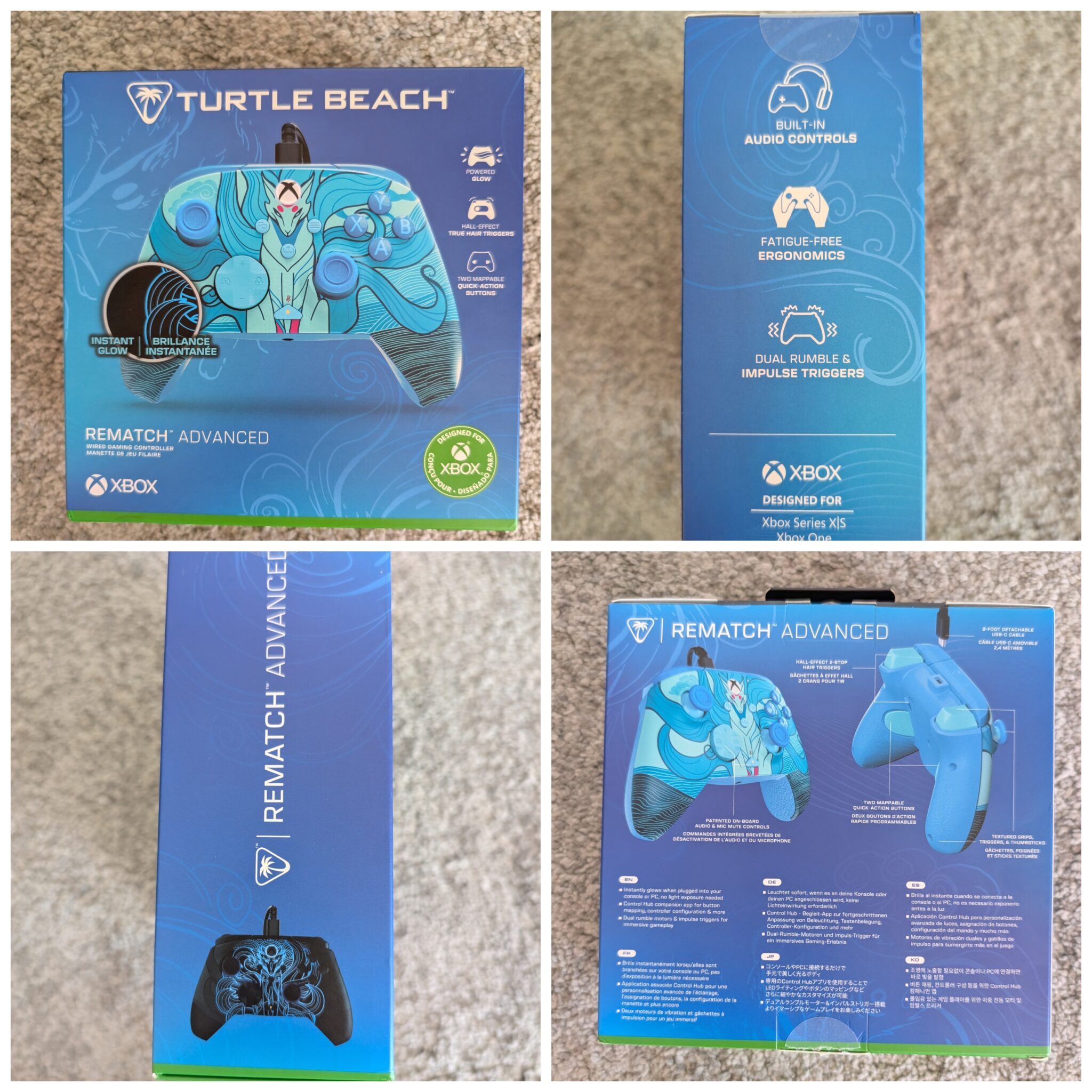
Commençons notre test par notre traditionnelle partie unboxing, ou nous retrouverons sur l’avant de la boîte un visuel de la manette, turquoise sur fond bleu, avec la mention de son côté brillant et phosphorescent.  Nous retrouverons, le tout en anglais, quelques unes de ses principaux atouts, sans oublier la mention « conçue pour Xbox », ce qui rassure ainsi tous les joueurs. À gauche, on nous rappellera le nom du produit avec un nouveau visuel de la mnatte, cette fois toute sombre avec ses dessins en surbrillance (superbe) et à droite à nouveau quelques fonctionnalités, fonctionnalités que nous listerons peu après.

En dessous, nous aurons et ce en plusieurs langues, le détail du contenu de la boîte et pour finir, à l’arrière, deux nouveaux visuels avec le reste des informations techniques, le tout en 6 langues.
Xbox Turtle Beach Rematch Advanced Blue Kitsune


Fonctionnalités et caractéristiques techniques

  • Conception légendaire – Inspirée du folklore japonais, la conception Blue Kitsune arbore des touches éclatantes et des détails audacieux qui donnent vie à l’esprit du renard mythique.
  • Éclairez votre chemin – La manette Blue Kitsune s’illumine instantanément lorsque vous la branchez. Pas d’exposition à la lumière nécessaire. L’éclat bleu vibrant apporte un style audacieux et une atmosphère particulière à votre configuration.
  • Gameplay personnalisable – Les gâchettes à 2 crans vous permettent d’ajuster la profondeur pour améliorer l’exactitude, la précision et le temps de réaction, tandis que les deux moteurs de vibration et les gâchettes à impulsion offrent un contrôle réactif, pour une expérience de gaming immersive.
  • Expérience immersive – Les deux moteurs de vibration et les gâchettes à impulsion offrent un retour dynamique, pour un réalisme plus poussé à chaque action. Ressentez chaque coup, accident et explosion avec précision, pour une meilleure immersion dans le gameplay.
  • Commandes audio brevetées – Ajustez facilement l’audio à la volée grâce aux commandes sur la croix directionnelle. Vous pouvez ainsi régler la balance sonore jeu/chat et le volume principal, et vous bénéficiez d’un bouton dédié pour couper le microphone.

Contenu

  • Manette Rematch Advanced
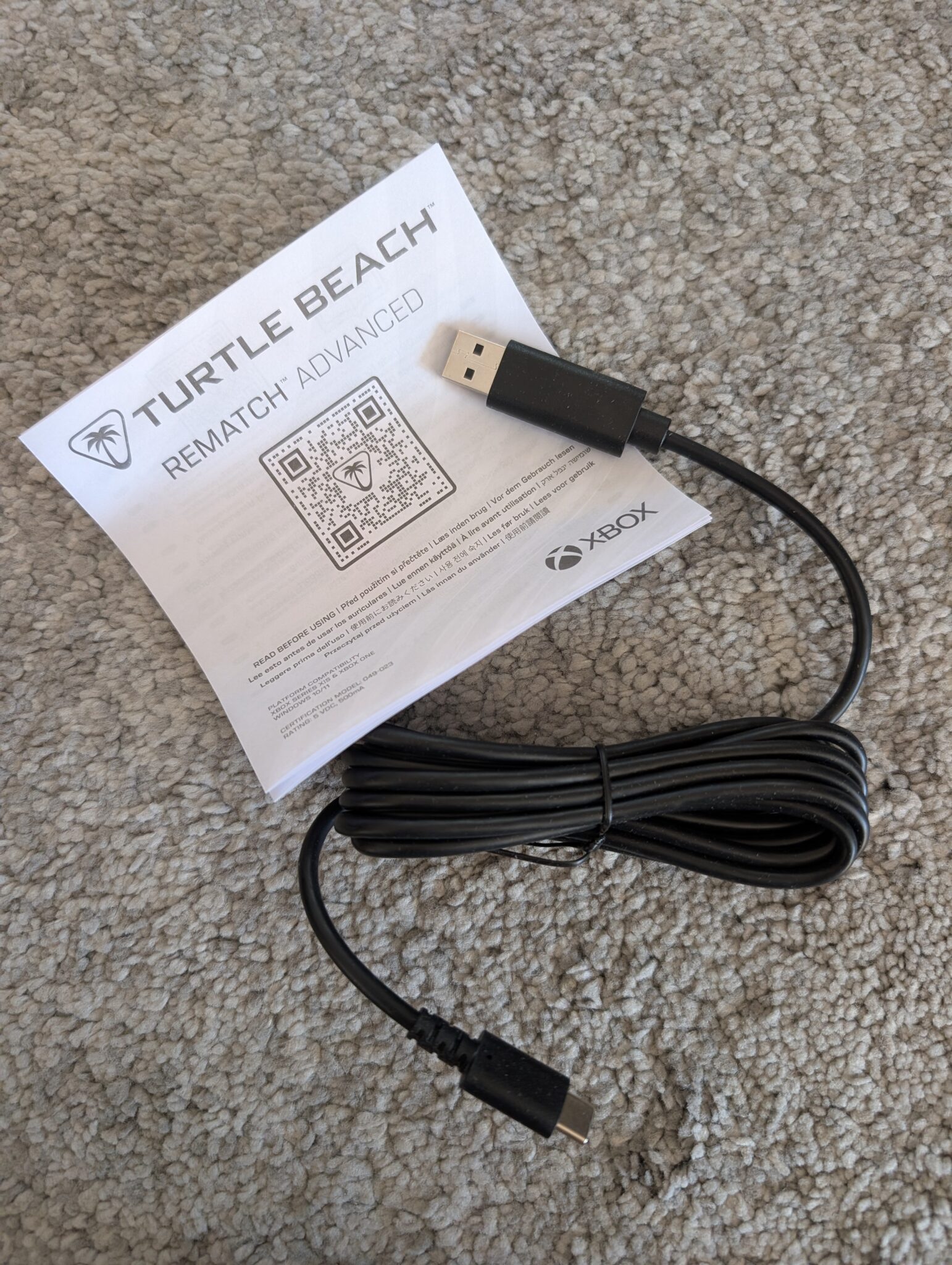
  • Câble USB-C 2,4m
  • Insertion à démarrage rapide

Xbox Turtle Beach Rematch Advanced Blue Kitsune


Test 

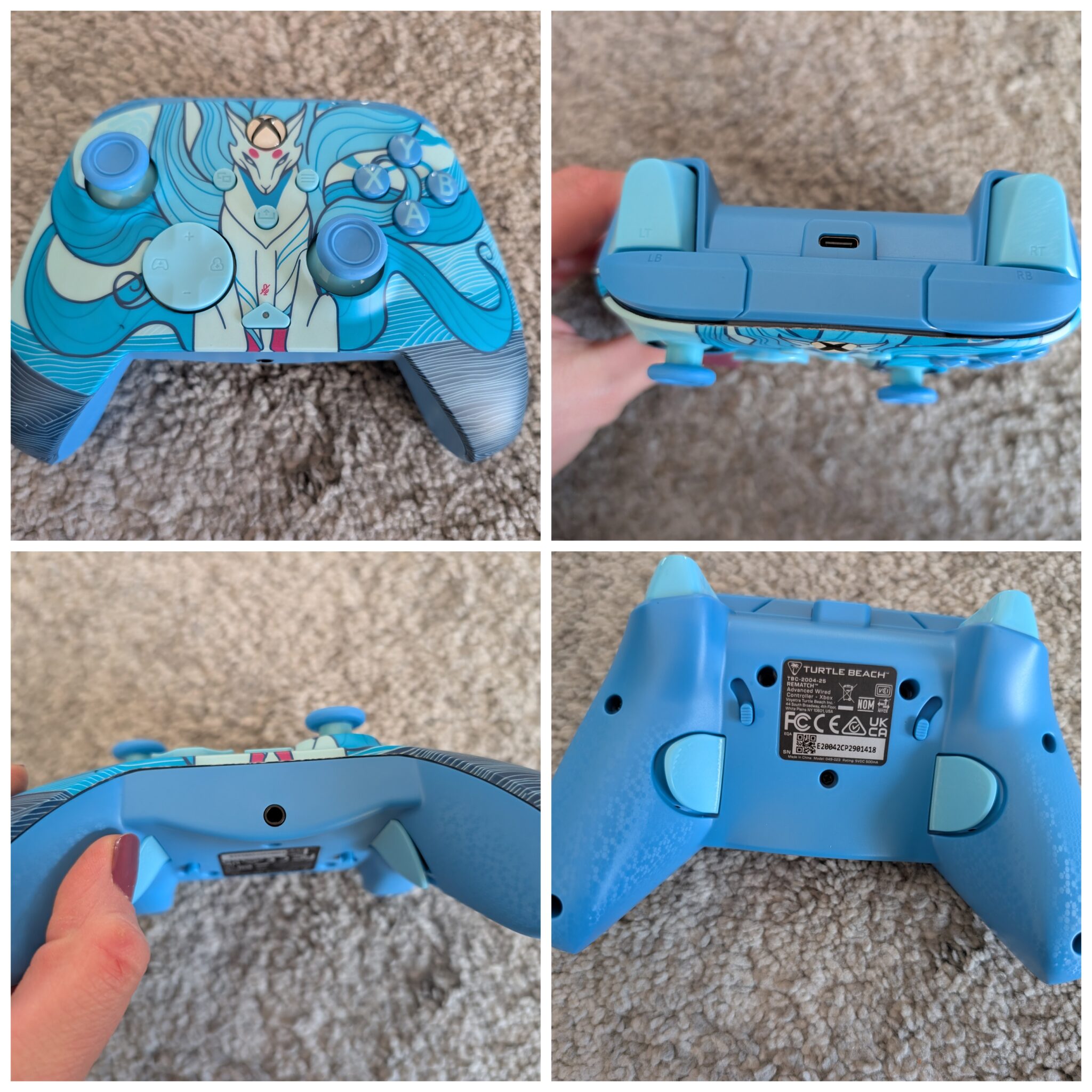
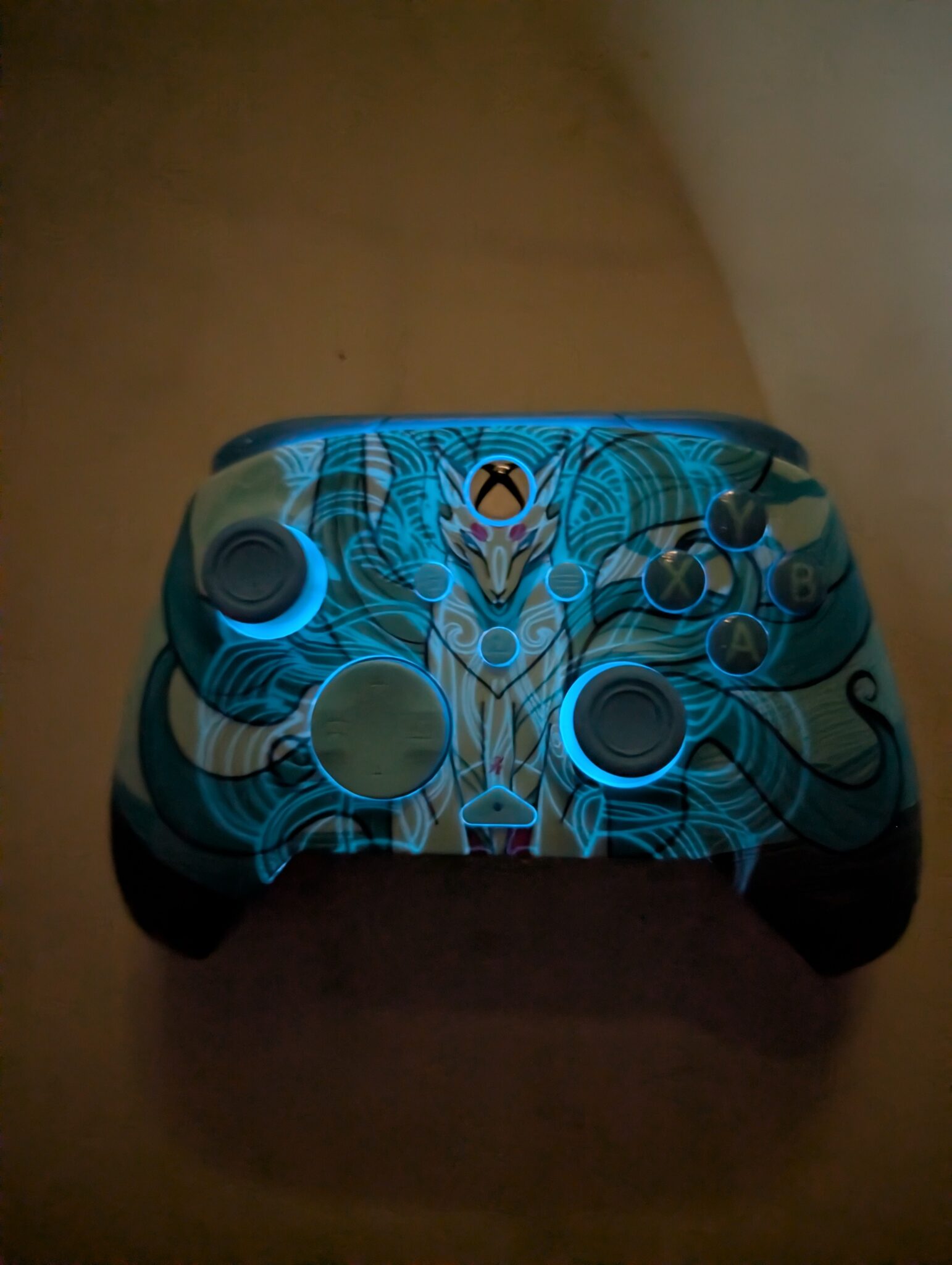
La première chose qui frappe, c’est évidemment ce bleu vif rehaussé d’un motif Kitsune stylisé, presque « cosmic fantasy », qui prend toute sa dimension lorsque la lumière baisse. La manette devient alors une sorte de totem gamer phosphorescent, une trouvaille qui évoque un mélange entre culture pop japonaise et esthétique cyber. On aime ou on n’aime pas, mais au moins, elle assume. Et dans un marché saturé de manettes noires, blanches ou « urban camo », ça change. La prise en main, elle, reste familière : on est sur une ergonomie très proche de la manette Xbox officielle, ce qui permet de s’adapter instantanément. Le châssis est plus léger que celui d’une manette sans fil, mais l’équilibre reste bon, sans effet « creux ». Après, ça, c’est aussi une question d’habitude et de goût.

Côté sensation en jeu, on peut dire que le tout est fiable, réactive et sans chichi inutile. La Rematch Advanced ne joue pas la carte du gadget à outrance : elle mise sur des fondamentaux solides.

Les sticks – Précis, stables, avec juste assez de résistance pour éviter les dérives incontrôlées.
Xbox Turtle Beach Rematch Advanced Blue Kitsune

Les gâchettes – Un point fort : elles offrent un retour bien calibré, ni trop spongieux ni trop secs. Sur des jeux de tir ou de conduite, la différence est notable par rapport à certaines manettes filaires d’entrée de gamme souvent trop molles.

Les boutons programmables – Deux boutons à l’arrière, facilement accessibles mais assez bien intégrés pour ne pas être activés par accident — à condition de ne pas jouer avec des mains de bûcheron. Idéal pour remplacer un saut, une glissade ou un rechargement rapide, selon votre style de jeu.

Une latence quasi inexistante grâce au câble – C’est l’avantage indiscutable des manettes filaires : zéro micro-coupure, zéro batterie qui agonise, zéro latence perceptible. Le câble tressé de 2,5 mètres laisse largement de quoi jouer sans se sentir attaché au meuble TV comme un chien à sa niche.
Xbox Turtle Beach Rematch Advanced Blue Kitsune

On connaît Turtle Beach pour ses casques, pas pour ses manettes. Et c’est précisément pour ça que la présence de commandes audio directement intégrées fait toute la différence.

Il suffit de brancher un casque en jack pour profiter :

  • du réglage du volume depuis la manette

  • de la gestion du mix jeu/chat

  • et surtout du mode Superhuman Hearing, la signature maison, qui amplifie certains sons clés (bruits de pas, rechargements ennemis…).

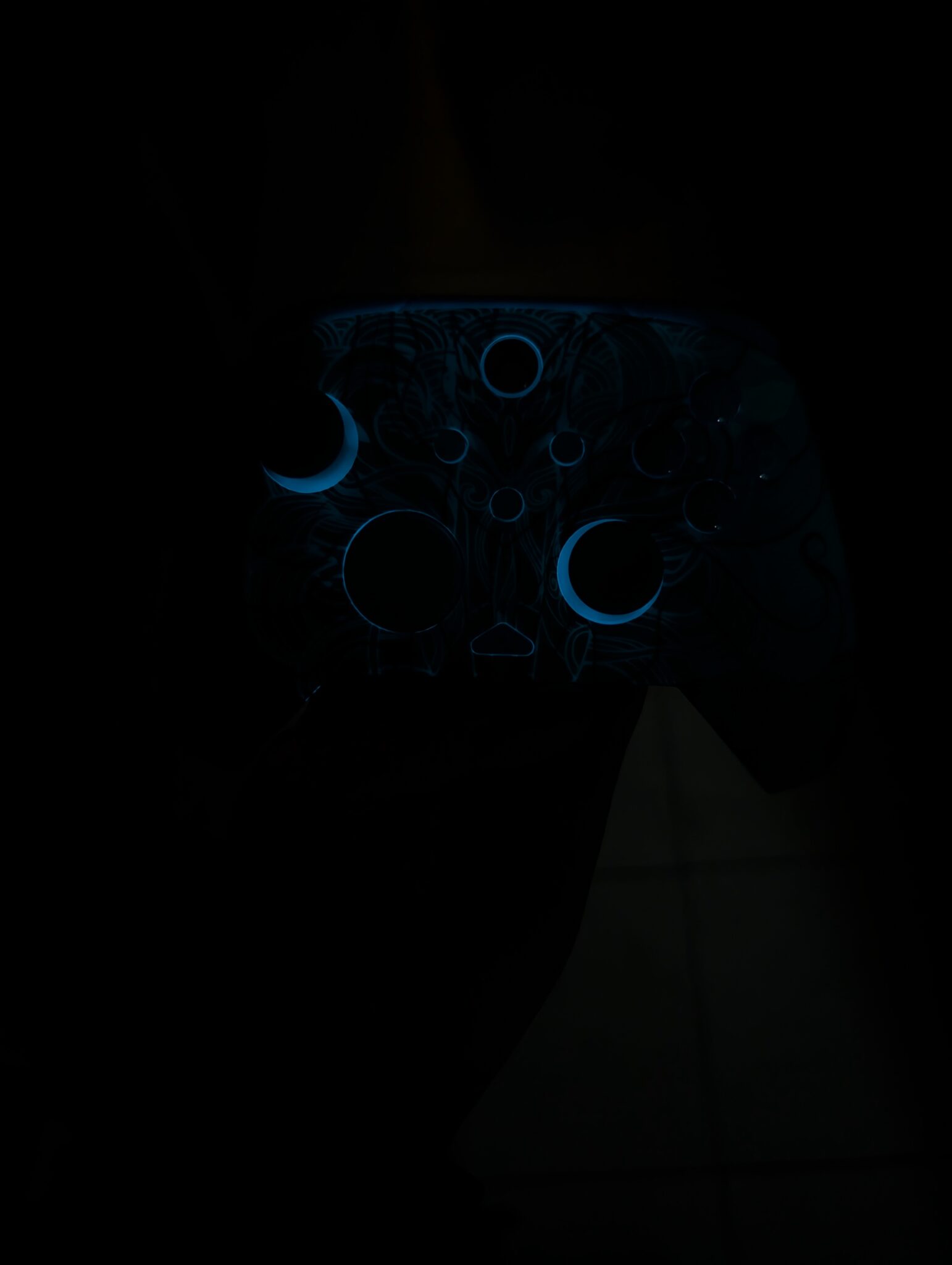
Testée sur Xbox One et PC, la manette a parfaitement fonctionné partout. Sur PC, aucun logiciel obligatoire, aucun driver exotique : on branche, ça marche. Le poids contenu est agréable sur la durée, même après de longues sessions. Le grip est plutôt correct, même si on aurait apprécié des surfaces légèrement plus texturées, surtout sur les poignées. Pour finir, l’effet glow-in-the-dark n’apporte rien à votre K/D ratio. Rien à votre performance non plus. Et pourtant, on a aimé. Le rendu est propre, visible sans être agressif, et donne un cachet vraiment atypique à la manette. Dans une pièce sombre, elle devient une petite sculpture lumineuse. Ce n’est pas indispensable, mais c’est fun — et parfois, c’est largement suffisant.
Xbox Turtle Beach Rematch Advanced Blue Kitsune

Conclusion 

La Turtle Beach Rematch Advanced Blue Kitsune est une bonne surprise : un produit pensé avec sérieux, mais qui ne renonce pas à se démarquer. Entre son ergonomie maîtrisée, ses boutons arrière programmables, ses commandes audio intégrées et son style phosphorescent totalement assumé, elle propose une expérience plus riche que beaucoup de manettes filaires dans la même gamme de prix.

Idéale comme manette principale pour les joueurs qui préfèrent la fiabilité du filaire, ou comme manette secondaire stylée pour le canapé du salon.

Turtle Beach signe ici un accessoire cohérent, fun, efficace — et qui n’essaie pas de jouer dans la cour des manettes premium à 150 €. Un bon rapport qualité/fonctionnalités pour les joueurs qui veulent autre chose que la manette Xbox standard, sans se ruiner.

Vous la retrouverez au prix de 39,99 €.

Test – Manette Xbox Turtle Beach Rematch Advanced Blue Kitsune a lire sur Vonguru.

  •  
❌