↩ Accueil

Vue lecture

Le MacBook Air M2 en promo à 699 €, son plus bas historique

Mise à jour 04/01 — 699 €, c’est le nouveau prix plancher du MacBook Air M2. Il était déjà disponible à ce prix chez Boulanger en milieu de semaine. C’est au tour de Darty de le proposer à ce prix en collaboration avec Rakuten. Pour bénéficier de cette offre, il suffit de saisir le code RAKUTEN50 lors de la commande. La transaction est gérée par Rakuten, mais la livraison est l’œuvre de Darty.

Cette configuration embarque 16 Go de RAM et 256 Go d’espace de stockage. Une offre à ne pas rater, si vous cherchez un Mac à petit prix.

Mise à jour 26/12 — Boulanger poursuit sa double remise sur le MacBook Air M2 minuit qui le fait tomber à seulement 724 €, son prix le plus bas. La machine est affichée à 749 €, mais une fois dans le panier, une remise supplémentaire de 25 € est appliquée.

MacBook Air M2 minuit. Image MacGeneration.

Lancé en 2022, le MacBook Air M2 est très agréable à utiliser : il est léger, silencieux, performant et endurant. Deux générations lui ont succédé, mais la formule n’a pas changé, si bien qu’il reste tout à fait dans le coup aujourd’hui. Les 16 Go de RAM sont suffisants pour les usages classiques. Les 256 Go de stockage peuvent, eux, être trop faibles pour certains, mais on peut pallier le problème avec un SSD externe.

Test du MacBook Air M2 : le saut dans l

Test du MacBook Air M2 : le saut dans l'air moderne


Mise à jour 20/12 — Petit à petit, le MacBook Air M2 se rapproche de la barre psychologique des 700 €. Ces derniers jours, on voit fleurir de plus en plus d’offres éphémères entre 720 et 750 €. Aujourd’hui, la meilleure nous vient du duo Rakuten / Darty : en saisissant le code DARTY10, vous pouvez obtenir le portable d’Apple à 739 €. Il s’agit d’une configuration avec 16 Go de RAM et 256 Go de SSD. La transaction est effectuée via Rakuten, mais la livraison est assurée par Darty. Amazon de son côté propose la même configuration pour 749 €.

Mise à jour 16/12 — Amazon riposte à son tour à Boulanger et propose le même MacBook Air M2 16 Go à 725 € !

Mise à jour 15/12 — En 2026, le prix des Mac pourrait à nouveau augmenter, mais 2026, c’est encore (un peu) loin. Autant dire qu’on ne reverra peut-être pas de si tôt un MacBook Air à 724 € ! À ce prix, vous pouvez obtenir chez Boulanger le MacBook Air M2 équipé de 16 Go et 256 de mémoire vive. Il s’agit bien entendu d’un modèle neuf ! Pour l’obtenir à ce prix, pensez à saisir le code NOEL25.
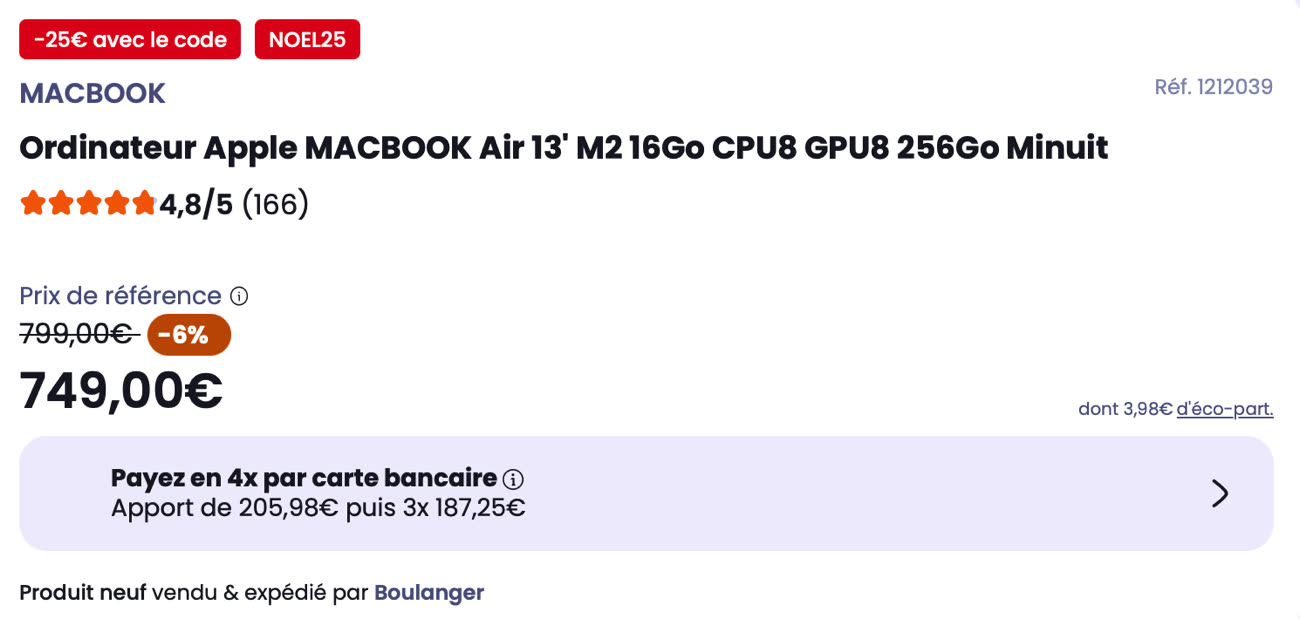
Mise à jour 11/12 — Le MacBook Air M2 est proposé ce jour à 749 € chez Boulanger ! Il s’agit du même modèle : 16 Go de RAM et 256 Go de SSD.

Mise à jour 09/12 — Depuis le Black Friday, les prix ont tendance à repartir à la hausse sur certaines configurations de Mac. Il reste toutefois de bonnes affaires à saisir ! Après avoir été proposé pendant quelques jours à 799 €, le MacBook Air M2 avec 16 Go de RAM et 256 Go de stockage est de nouveau affiché à 775 €. Mais la vraie surprise vient de Cdiscount, qui ne s’est pas contenté de s’aligner : le site dégaine une contre-offensive encore plus agressive. Avec le code MBA25, le même MacBook Air M2 tombe à 750 €, tout simplement l’un des meilleurs prix jamais vus pour ce modèle.

Le MacBook Air M4, lui, est proposé à 942,11 €. Il était resté longtemps à 899 €.

Mise à jour 3/12 — Amazon vient de baisser à nouveau le prix du MacBook Air M2 16 Go. Il est proposé au prix de 748 € !

Mise à jour 26/11 — Chaque jour, le MacBook Air M2 abandonne quelques euros. Le voilà disponible pour 773 € sur Amazon ! Pour l’avoir à ce prix, il vous faut activer le coupon qui est proposé !

Mise à jour 21/11 — Le prix du MacBook Air M2 repart à la baisse sur Amazon. Il est affiché ce jour à 798 €, mais Amazon lui retranche 15 € au moment de passer la commande. Ce qui nous ramène le MacBook Air M2 à 783 € !

Mise à jour le 14 novembre 14:10 : Le prix du MacBook Air M2 continue de dégringoler : on peut l’obtenir pour 773 € en ce moment chez Cdiscount. Il faudra pour cela entrer le code POMME25 à l’étape du paiement. Il s’agit de la version 256 Go et avec 16 Go de RAM. La machine est vendue et expédiée par Cdiscount. Ne traînez pas trop, car rien n’indique jusqu’à quand l’offre restera en ligne.

Article original : Si Apple a diminué récemment le prix du MacBook Air M4 13 pouces, qui est passé à 1 099 €, il n'y a pas encore de Mac portable réellement low cost dans la gamme… du moins pas chez Apple directement. En effet, de nombreux revendeurs proposent encore le MacBook Air M2 à la vente, dans sa variante dotée de 16 Go de RAM et de 256 Go de stockage. Et Amazon propose même une (petite) réduction : il est à 798 €, son prix le plus bas chez Amazon1.
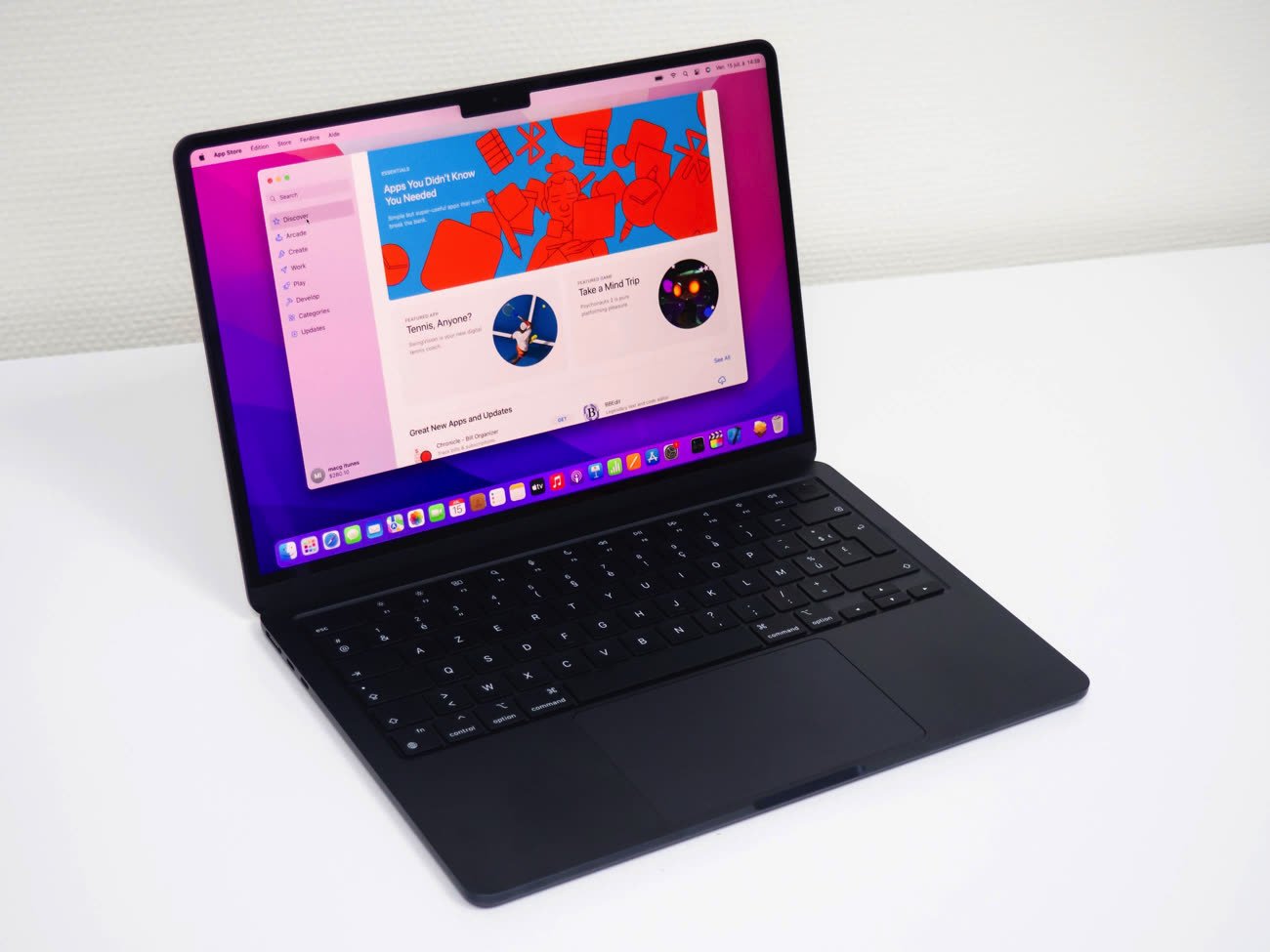
Le MacBook Air M2 en version Minuit. Image MacGeneration

La machine a été lancée en 2022 à 1 500 € (avec 8 Go de RAM), et c'est un ordinateur portable toujours performant, très autonome et silencieux, contrairement aux MacBook Pro M5, par exemple. Le MacBook Air M4 a évidemment un système sur puce plus moderne et plus performant, mais la puce M2 ne démérite pas. C'est la version noire (Minuit) qui est proposée à ce prix, et elle n'a qu'un défaut : elle est (très) sensible aux traces de doigts. Mais pour le reste, le MacBook Air M2 reste un excellent appareil, surtout à ce prix.


  1. Soyons honnêtes : il est depuis quelques semaines à 799 €, mais ça reste une bonne affaire souvent méconnue.  ↩︎
  •  

Fluid-based laser scanning technique could improve brain imaging

Using a new type of low-power, compact, fluid-based prism to steer the beam in a laser scanning microscope could transform brain imaging and help researchers learn more about neurological conditions such as Alzheimer’s disease.

The “electrowetting prism” utilized was developed by a team led by Juliet Gopinath from the electrical, computer and energy engineering and physics departments at the University of Colorado at Boulder (CU Boulder) and Victor Bright from CU Boulder’s mechanical engineering department, as part of their ongoing collaboration on electrically controllable optical elements for improving microscopy techniques.

“We quickly became interested in biological imaging, and work with a neuroscience group at University of Colorado Denver Anschutz Medical Campus that uses mouse models to study neuroscience,” Gopinath tells Physics World. “Neuroscience is not well understood, as illustrated by the neurodegenerative diseases that don’t have good cures. So a great benefit of this technology is the potential to study, detect and treat neurodegenerative diseases such as Alzheimer’s, Parkinson’s and schizophrenia,” she explains.

The researchers fabricated their patented electrowetting prism using custom deposition and lithography methods. The device consists of two immiscible liquids housed in a 5 mm tall, 4 mm diameter glass tube, with a dielectric layer on the inner wall coating four independent electrodes. When an electric field is produced by applying a potential difference between a pair of electrodes on opposite sides of the tube, it changes the surface tension and therefore the curvature of the meniscus between the two liquids. Light passing through the device is refracted by a different amount depending on the angle of tilt of the meniscus (as well as on the optical properties of the liquids chosen), enabling beams to be steered by changing the voltage on the electrodes.

Beam steering for scanning in imaging and microscopy can be achieved via several means, including mechanically controlled mirrors, glass prisms or acousto-optic deflectors (in which a sound wave is used to diffract the light beam). But, unlike the new electrowetting prisms, these methods consume too much power and are not small or lightweight enough to be used for miniature microscopy of neural activity in the brains of living animals.

In tests detailed in Optics Express, the researchers integrated their electrowetting prism into an existing two-photon laser scanning microscope and successfully imaged individual 5 µm-diameter fluorescent polystyrene beads, as well as large clusters of those beads.

They also used computer simulation to study how the liquid–liquid interface moved, and found that when a sinusoidal voltage is used for actuation, at 25 and 75 Hz, standing wave resonance modes occur at the meniscus – a result closely matched by a subsequent experiment that showed resonances at 24 and 72 Hz. These resonance modes are important for enhancing device performance since they increase the angle through which the meniscus can tilt and thus enable optical beams to be steered through a greater range of angles, which helps minimize distortions when raster scanning in two dimensions.

Bright explains that this research built on previous work in which an electrowetting prism was used in a benchtop microscope to image a mouse brain. He cites seeing the individual neurons as a standout moment that, coupled with the current results, shows their prism is now “proven and ready to go”.

Gopinath and Bright caution that “more work is needed to allow human brain scans, such as limiting voltage requirements, allowing the device to operate at safe voltage levels, and miniaturization of the device to allow faster scan speeds and acquiring images at a much faster rate”. But they add that miniaturization would also make the device useful for endoscopy, robotics, chip-scale atomic clocks and space-based communication between satellites.

The team has already begun investigating two other potential applications: LiDAR (light detection and ranging) systems and optical coherence tomography (OCT). Next, the researchers “hope to integrate the device into a miniaturized microscope to allow imaging of the brain in freely moving animals in natural outside environments,” they say. “We also aim to improve the packaging of our devices so they can be integrated into many other imaging systems.”

The post Fluid-based laser scanning technique could improve brain imaging appeared first on Physics World.

  •  

Intrigued by quantum? Explore the 2025 Physics World Quantum Briefing 2.0

To coincide with a week of quantum-related activities organized by the Institute of Physics (IOP) in the UK, Physics World has just published a free-to-read digital magazine to bring you up to date about all the latest developments in the quantum world.

The 62-page Physics World Quantum Briefing 2.0 celebrates the International Year of Quantum Science and Technology (IYQ) and also looks ahead to a quantum-enhanced future.

Marking 100 years since the advent of quantum mechanics, IYQ aims to raise awareness of the impact of quantum physics and its myriad future applications, with a global diary of quantum-themed public talks, scientific conferences, industry events and more.

The 2025 Physics World Quantum Briefing 2.0, which follows on from the first edition published in May, contains yet more quantum topics for you to explore and is once again divided into “history”, “mystery” and “industry”.

You can find out more about the contributions of Indian physicist Satyendra Nath Bose to quantum science; explore weird phenomena such as causal order and quantum superposition; and discover the latest applications of quantum computing.

A century after quantum mechanics was first formulated, many physicists are still undecided on some of the most basic foundational questions. There’s no agreement on which interpretation of quantum mechanics holds strong; whether the wavefunction is merely a mathematical tool or a true representation of reality; or what impact an observer has on a quantum state.

Some of the biggest unanswered questions in physics – such as finding the quantum/classical boundary or reconciling gravity and quantum mechanics – lie at the heart of these conundrums. So as we look to the future of quantum – from its fundamentals to its technological applications – let us hope that some answers to these puzzles will become apparent as we crack the quantum code to our universe.

This article forms part of Physics World‘s contribution to the 2025 International Year of Quantum Science and Technology (IYQ), which aims to raise global awareness of quantum physics and its applications.

Stayed tuned to Physics World and our international partners throughout the year for more coverage of the IYQ.

Find out more on our quantum channel.

The post Intrigued by quantum? Explore the 2025 <em>Physics World Quantum Briefing 2.0</em> appeared first on Physics World.

  •  

Sortie Michel Lafon – Just Twilight Tomes 1 et 2

Sortie Michel Lafon – Just Twilight Tomes 1 et 2

Les éditions Michel Lafon nous dévoilent un tout nouveau webtoon en ce mois d’octobre : Just Twilight de Kang Ki et Woo Jihye. En plus, l’éditeur nous ravie avec la sortie des deux premiers tomes simultanément.


Just Twilight – sortie des tomes 1 et 2

Pour le tome 1 collector : une couverture métallisée exclusive, contenant 4 ex-libris format polaroïds, une planche de stickers et un marque-page !

Just Twilight Just Twilight

Joon-yeong, meilleure élève de son lycée, cherche désespérément un refuge pour étudier, loin du domicile familial qu’elle fuit. Par hasard, elle découvre une maison abandonnée dans la forêt, idéale pour travailler en paix. Mais le lieu est déjà occupé : Beom-jin, son camarade de classe à mauvaise réputation, s’y cache lui aussi. Une étrange cohabitation se met alors en place entre ces deux lycéens que tout oppose, unis par l’envie de préserver ce havre secret. Et dans ce lieu hors du monde, quelque chose d’inattendu pourrait bien naître.

Just Twilight

Les tomes 1 et 2 sont sortis simultanément le 16 octobre dernier. Le premier tome est disponible au tarif de 16,95 € tandis que vous trouverez tome 2 pour 14,95 €.

Sortie Michel Lafon – Just Twilight Tomes 1 et 2 a lire sur Vonguru.

  •  
❌