↩ Accueil

Vue lecture

Performance metrics and benchmarks point the way to practical quantum advantage

Quantum connections Measurement scientists are seeking to understand and quantify the relative performance of quantum computers from different manufacturers as well as across the myriad platform technologies. (Courtesy: iStock/Bartlomiej Wroblewski)

From quantum utility today to quantum advantage tomorrow: incumbent technology companies – among them Google, Amazon, IBM and Microsoft – and a wave of ambitious start-ups are on a mission to transform quantum computing from applied research endeavour to mainstream commercial opportunity. The end-game: quantum computers that can be deployed at-scale to perform computations significantly faster than classical machines while addressing scientific, industrial and commercial problems beyond the reach of today’s high-performance computing systems.

Meanwhile, as technology translation gathers pace across the quantum supply chain, government laboratories and academic scientists must maintain their focus on the “hard yards” of precompetitive research. That means prioritizing foundational quantum hardware and software technologies, underpinned by theoretical understanding, experimental systems, device design and fabrication – and pushing out along all these R&D pathways simultaneously.

Bringing order to disorder

Equally important is the requirement to understand and quantify the relative performance of quantum computers from different manufacturers as well as across the myriad platform technologies – among them superconducting circuits, trapped ions, neutral atoms as well as photonic and semiconductor processors. A case study in this regard is a broad-scope UK research collaboration that, for the past four years, has been reviewing, collecting and organizing a holistic taxonomy of metrics and benchmarks to evaluate the performance of quantum computers against their classical counterparts as well as the relative performance of competing quantum platforms.

Funded by the National Quantum Computing Centre (NQCC), which is part of the UK National Quantum Technologies Programme (NQTP), and led by scientists at the National Physical Laboratory (NPL), the UK’s National Metrology Institute, the cross-disciplinary consortium has taken on an endeavour that is as sprawling as it is complex. The challenge lies in the diversity of quantum hardware platforms in the mix; also the emergence of two different approaches to quantum computing – one being a gate-based framework for universal quantum computation, the other an analogue approach tailored to outperforming classical computers on specific tasks.

“Given the ambition of this undertaking, we tapped into a deep pool of specialist domain knowledge and expertise provided by university colleagues at Edinburgh, Durham, Warwick and several other centres-of-excellence in quantum,” explains Ivan Rungger, a principal scientist at NPL, professor in computer science at Royal Holloway, University of London, and lead scientist on the quantum benchmarking project. That core group consulted widely within the research community and with quantum technology companies across the nascent supply chain. “The resulting study,” adds Rungger, “positions transparent and objective benchmarking as a critical enabler for trust, comparability and commercial adoption of quantum technologies, aligning closely with NPL’s mission in quantum metrology and standards.”

Not all metrics are equal – or mature

2025-10-npl-na-aqml-image
Made to measure NPL’s Institute for Quantum Standards and Technology (above) is the UK’s national metrology institute for quantum science. (Courtesy: NPL)

For context, a number of performance metrics used to benchmark classical computers can also be applied directly to quantum computers, such as the speed of operations, the number of processing units, as well as the probability of errors to occur in the computation. That only goes so far, though, with all manner of dedicated metrics emerging in the past decade to benchmark the performance of quantum computers – ranging from their individual hardware components to entire applications.

Complexity reigns, it seems, and navigating the extensive literature can prove overwhelming, while the levels of maturity for different metrics varies significantly. Objective comparisons aren’t straightforward either – not least because variations of the same metric are commonly deployed; also the data disclosed together with a reported metric value is often not sufficient to reproduce the results.

“Many of the approaches provide similar overall qualitative performance values,” Rungger notes, “but the divergence in the technical implementation makes quantitative comparisons difficult and, by extension, slows progress of the field towards quantum advantage.”

The task then is to rationalize the metrics used to evaluate the performance for a given quantum hardware platform to a minimal yet representative set agreed across manufacturers, algorithm developers and end-users. These benchmarks also need to follow some agreed common approaches to fairly and objectively evaluate quantum computers from different equipment vendors.

With these objectives in mind, Rungger and colleagues conducted a deep-dive review that has yielded a comprehensive collection of metrics and benchmarks to allow holistic comparisons of quantum computers, assessing the quality of hardware components all the way to system-level performance and application-level metrics.

Drill down further and there’s a consistent format for each metric that includes its definition, a description of the methodology, the main assumptions and limitations, and a linked open-source software package implementing the methodology. The software transparently demonstrates the methodology and can also be used in practical, reproducible evaluations of all metrics.

“As research on metrics and benchmarks progresses, our collection of metrics and the associated software for performance evaluation are expected to evolve,” says Rungger. “Ultimately, the repository we have put together will provide a ‘living’ online resource, updated at regular intervals to account for community-driven developments in the field.”

From benchmarking to standards

Innovation being what it is, those developments are well under way. For starters, the importance of objective and relevant performance benchmarks for quantum computers has led several international standards bodies to initiate work on specific areas that are ready for standardization – work that, in turn, will give manufacturers, end-users and investors an informed evaluation of the performance of a range of quantum computing components, subsystems and full-stack platforms.

What’s evident is that the UK’s voice on metrics and benchmarking is already informing the collective conversation around standards development. “The quantum computing community and international standardization bodies are adopting a number of concepts from our approach to benchmarking standards,” notes Deep Lall, a quantum scientist in Rungger’s team at NPL and lead author of the study. “I was invited to present our work to a number of international standardization meetings and scientific workshops, opening up widespread international engagement with our research and discussions with colleagues across the benchmarking community.”

He continues: “We want the UK effort on benchmarking and metrics to shape the broader international effort. The hope is that the collection of metrics we have pulled together, along with the associated open-source software provided to evaluate them, will guide the development of standardized benchmarks for quantum computers and speed up the progress of the field towards practical quantum advantage.”

That’s a view echoed – and amplified – by Cyrus Larijani, NPL’s head of quantum programme. “As we move into the next phase of NPL’s quantum strategy, the importance of evidence-based decision making becomes ever-more critical,” he concludes. “By grounding our strategic choices in robust measurement science and real-world data, we ensure that our innovations not only push the boundaries of quantum technology but also deliver meaningful impact across industry and society.”

Further reading

Deep Lall et al. 2025 A  review and collection of metrics and benchmarks for quantum computers: definitions, methodologies and software https://arxiv.org/abs/2502.06717

The headline take from NQCC

Quantum computing technology has reached the stage where a number of methods for performance characterization are backed by a large body of real-world implementation and use, as well as by theoretical proofs. These mature benchmarking methods will benefit from commonly agreed-upon approaches that are the only way to fairly, unambiguously and objectively benchmark quantum computers from different manufacturers.

“Performance benchmarks are a fundamental enabler of technology innovation in quantum computing,” explains Konstantinos Georgopoulos, who heads up the NQCC’s quantum applications team and is responsible for the centre’s liaison with the NPL benchmarking consortium. “How do we understand performance? How do we compare capabilities? And, of course, what are the metrics that help us to do that? These are the leading questions we addressed through the course of this study.

”If the importance of benchmarking is a given, so too is collaboration and the need to bring research and industry stakeholders together from across the quantum ecosystem. “I think that’s what we achieved here,” says Georgopoulos. “The long list of institutions and experts who contributed their perspectives on quantum computing was crucial to the success of this project. What we’ve ended up with are better metrics, better benchmarks, and a better collective understanding to push forward with technology translation that aligns with end-user requirements across diverse industry settings.”

End note: NPL retains copyright on this article.

The post Performance metrics and benchmarks point the way to practical quantum advantage appeared first on Physics World.


  •  

Quantum computing and AI join forces for particle physics

This episode of the Physics World Weekly podcast explores how quantum computing and artificial intelligence can be combined to help physicists search for rare interactions in data from an upgraded Large Hadron Collider.

My guest is Javier Toledo-Marín, and we spoke at the Perimeter Institute in Waterloo, Canada. As well as having an appointment at Perimeter, Toledo-Marín is also associated with the TRIUMF accelerator centre in Vancouver.

Toledo-Marín and colleagues have recently published a paper called “Conditioned quantum-assisted deep generative surrogate for particle–calorimeter interactions”.

Delft logo

This podcast is supported by Delft Circuits.

As gate-based quantum computing continues to scale, Delft Circuits provides the i/o solutions that make it possible.

The post Quantum computing and AI join forces for particle physics appeared first on Physics World.

  •  

Edito | La Presse Jeux Vidéo est Morte ?

Si vous avez grandi dans les années 80 et 90, la simple vision d’un magazine de jeux vidéo vous fait très certainement encore quelque chose. Sur ce titre pessimiste, j’avais besoin de vous donner mon avis sur la mort lente et douloureuse de la presse gaming. Dans cet édito, j’aimerais vous détailler ce qui explique, selon moi, le déclin de ce média qui n’a plus grand chose d’intéressant à offrir. Et pourquoi nous en sommes arrivés là. Bonne lecture !

Mort de la presse Gaming

Préambule

J’ai créé Playerone.tv en décembre 2009. C’est à la fois lointain et proche. Sur certains points, on croirait en effet parler du siècle dernier tant les choses ont changées. A cette époque là, il y avait une véritable guerre des « nouveaux sites de jeux vidéo » qui tentaient tous de sortir de l’anonymat. C’était une concurrence assez bizarre par ailleurs.

Mais de 2009 à 2015, la presse était LE point central de l’information autour des jeux vidéo, consoles et PC. Les magazines disparaissaient alors logiquement un par un, par manque d’intérêt et de réactivité de l’information. Les jeux sortaient par dizaines de février à avril, puis de septembre à novembre. On ne savait plus où donner de la tête en étant quelques rédacteurs. Les éditeurs étaient en mode « séduction » dès que les statistiques de fréquentation des sites étaient potentiellement bons pour faire parler de leurs projets : communiqués de presse en pagaille, invitations à des sessions de jeux bêta, soirées spécialement dédiées à la presse, jeux reçus en avance pour les tester dans de bonnes conditions etc.

La faute des joueurs et lecteurs ?

La première raison du déclin est à mettre sur le dos des joueurs / lecteurs. Si les sites ferment les uns après les autres, c’est avant tout parce qu’ils ne cliquent plus sur les articles. Et qu’ils ne font quasiment plus de recherches sur internet. Pourquoi ? Selon moi, il y a deux raisons majeures.

Raison N°1 : Les publicités ont tué Internet
J’en suis le premier agacé : il est parfois impossible de lire le contenu d’un article sans que celui-ci ne soit noyé, voire souvent TOTALEMENT superposé par des publicités. Cela fait des années que j’utilise un bloqueur de pubs. Plus les lecteurs en ont utilisé un, plus les gros sites ont démultipliés les formats toujours plus intrusifs les uns des autres. Le serpent s’est mordu la queue jusqu’à se manger lui-même.

Un visiteur avec un bloqueur de publicité, c’est zéro centime qui entre dans la poche du site. C’est quelque part mérité, beaucoup ayant vraiment trop abusés ! Mais quand ton site n’affiche que peu de formats non intrusifs, tu payes quand même les débordements des autres.

Raison N°2 : Les articles pour ne rien dire et le putaclick / clickbait
Pour maximiser les profits sur un article, on a beaucoup vu leur substance diminuer. Un gros titre bien accrocheur (voire mensonger ou n’ayant aucun lien avec le sujet de l’article), trois ou quatre lignes de texte, et c’est parti ! On a souvent l’impression de ne rien apprendre.

Sur ce point, c’est aussi la faute des éditeurs et constructeurs qui ne livrent plus assez de détails dans leurs annonces pour en faire quelque chose d’intéressant. La plupart des communiqués tenant en un Tweet, il est compliqué d’en extraire de la substance. Si avant nous avions des communiqués de presse complet, l’information est aujourd’hui totalement morcelée. On reçoit au compte gouttes : date de sortie, teaser du trailer, annonce de la date de publication du trailer, des trailers qui ne racontent pas grand chose, et du gameplay qui ne dévoile quasi rien. C’est ultra superficiel et donc vide de substance exploitable pour une véritable travail journalistique.

Au-delà d’être journaliste, je suis aussi et surtout un joueur. Et tout comme vous, je me suis lassé d’aller sur des sites d’actualité jeux vidéo pour ces deux raisons. Je n’en consulte plus aucun en France, et seulement quelques uns aux USA. Avec Adblock bien entendu…

La faute des médias ?

Pour payer les pigistes et / ou les rédacteurs, il faut de l’argent. D’où vient l’argent des sites ? De la publicité. Avec le paragraphe précédent, j’imagine que vous avez déjà compris pourquoi la presse jeux vidéo est quasiment morte. Entre les bloqueurs de publicité qui transforment les visiteurs en fantômes financiers et le désintérêt des joueurs envers la presse, il est logique de voir tant de médias disparaitre.

Et une fois que les joueurs ont perdu cette habitude de lecture et de recherches autonomes sur un jeu vidéo, il me paraît impossible de faire machine arrière. Les réseaux sociaux ont remplacé totalement le lieu où l’information doit être dévoilée.

En 15 ans, Facebook, YouTube, TikTok et Instagram ont tué les sites internet d’actualité gaming. Leurs algorithmes aussi. Puisqu’il faut être toujours plus sensationnel dans le contenu pour être lu et partagé, cela a participé à la dégradation en qualité des médias. Il suffit de regarder ce qui marche le mieux en France pour s’en convaincre…

La faute des constructeurs et éditeurs ?

Autre point qui me paraît important : Il est impossible de faire un vrai travail journalistique dans le secteur des jeux vidéo. Cela n’a jamais été possible, et cela ne le sera très certainement jamais. La raison ? Les éditeurs et constructeurs souhaitent contrôler leur communication de A à Z. La place à l’investigation est donc verrouillée de tous les côtés. Si vous avez la chance d’accéder à un jeu avant sa sortie, c’est le NDA (accord de non divulgation) qui vous musèle.

Si vous souhaitez obtenir des informations sur un jeu en cours de développement, la seule réponse que vous obtiendrez est, au mieux : « nous communiquerons lorsque nous serons prêts ». Au fil de mes nombreuses interviews de ces 16 dernières années, je n’ai littéralement JAMAIS ramené un scoop. Même en « cuisinant » les développeurs, éditeurs et constructeurs rencontrés, ils ne lâchent RIEN. Ce n’est souvent pas l’envie qui manque, mais la peur de la sanction, puisqu’ils ne doivent pas dire autre chose que ce qui est prévu.

Depuis 2021, l’actualité est souvent morte. De phases de désert d’actualités en phases de maigres sorties, difficile de maintenir une communauté en haleine. C’est d’ailleurs cette pénurie de matière première que tant de rumeurs et fake news tombent de partout. Il faut faire du chiffre quand même !

Avec une industrie du jeu vidéo AAA en crise, la scène indépendante aurait pu prendre le relai. Mais les jeux indé n’intéressent quasiment personne. On ne peut pas faire tourner une boutique avec cela. C’est triste, mais c’est comme ça.

La faute des influenceurs ?

Quelle insulte, lorsque certaines entreprises me contactent en me collant directement dans la case « influenceur » parce que je fais des vidéos sur les réseaux sociaux… Mais passons. Aujourd’hui, il n’y en a que pour eux. Je ne dis pas ça par jalousie, mais par constat. Leur audience est tellement aveuglée par diverses choses que c’est du pain béni pour les éditeurs, et ces fameux influenceurs. Toute une économie s’est créée autour d’eux : liens d’affiliation, codes promo, vidéos sponsorisées, opérations spéciales etc. C’est aujourd’hui le moyen le mieux rémunéré pour faire de l’actualité gaming. Quand ça marche.

Mais en martelant leurs chaînes de contenus, plusieurs fois par jour, quitte à ne rien dire de nouveau sur 12 vidéos de GTA 6, ils retiennent leur audience chez eux. Un cercle fermé de joueurs qui ne se renseignent plus ailleurs. L’information tombe tout cuit dans le bec des scrolleurs infinis de réseaux sociaux. Plus besoin d’aller chercher par soi-même !

Une évolution logique d’un modèle démodé

Tout comme la lecture de livres et magazines papiers, la lecture d’articles (je dis bien articles, et pas « news » de 12 mots) est en train de mourir. Tout se passe sur les réseaux sociaux aujourd’hui. Et un réseau peut devenir démodé en l’espace de quelques années seulement. Cela ne serait pas un problème si ces plateformes n’étaient pas régies par des algorithmes sournois qui incitent à faire du sensationnel pour sortir de la masse. Avoir une communauté de 100 000 personnes ne garantit en effet pas que la totalité de vos abonnés verront passer votre contenu dans leur fil d’actualité.

Ce n’est même quasiment jamais le cas. Cela a également participé à l’effondrement de la qualité des contenus sur internet, puisque seuls quelques rares types d’actu arrivent à percer le mur de votre noyau communautaire.

Ce que je remarque en revanche depuis 16 ans n’est pas très glorieux : la feignantise a remplacé la curiosité. Avec des outils d’accès à l’information ultra performants, la plupart des joueurs ne font qu’attendre que l’actualité ne tombe du ciel. Inondés de contenus en tous genres sur une ribambelle d’applications mobiles, c’est aujourd’hui aux médias d’aller chercher les lecteurs où ils sont, et plus l’inverse.

L’arrivée de l’I.A : Le clou sur le cercueil !

Autre exemple de ce que la technologie peut donner de pire en termes de feignantise ? L’arrivée de l’I.A. Si Grok dit que c’est vrai, c’est que c’est vrai ! Je vois même de plus en plus de contenus écrits par Intelligence Artificielle. L’avenir des sites reposera-t-il sur de la rédaction automatisée à 100% ? Fort probable, et c’est pour moi le dernier clou du cercueil d’une presse déjà en état de mort cérébrale depuis pas mal d’années.

Je ne me pose pas en « vieux con », l’I.A pouvant avoir de chouettes avantages pour économiser du temps. Mais faire confiance aveuglément à un robot n’est pas la meilleure preuve d’évolution de l’humanité en ce qui me concerne…

Les conséquences de tout cela

1200 journalistes partis en 2 ans. C’est ce que révèle le fondateur de Press Engine, plateforme sur laquelle je suis inscrit également. Et selon lui, le pire n’est pas encore passé. Il explique cela également par la perte d’intérêt des lecteurs avec l’avènement des jeux service qui n’ont pas besoin de la presse pour vivre.

Le problème est que plus aucun jeu vidéo n’a besoin de la presse pour vivre. Seuls restent quelques irréductibles qui aiment lire, se renseigner, comparer les avis de différents médias. Le grand public, lui, se contente d’ouvrir le bec et de picorer ce qui tombe sous son nez. Encore une fois, ce n’est pas une critique, juste la réalité des faits.

Que devient Playerone.tv alors ?

Cela fait maintenant plusieurs mois que je n’écris plus d’articles d’actualité sur le site. Je réserve cela à Facebook et Instagram, cela touche en effet beaucoup plus de monde. Je réserve Playerone.tv pour les tests écrits des jeux, et pour m’exprimer par éditos comme avec celui-ci. J’ai pris cette décision l’année dernière, après plusieurs années à voir les statistiques chuter.

La débilisation de l’actualité gaming

Il n’y a malheureusement plus que ça qui marche. A grande échelle tout du moins. Quand vous regardez les YouTubers qui font le plus de clics, et les rares sites internet qui fonctionnent encore, c’est souvent une insulte à l’intelligence humaine. Le ton de parole est infantilisant. Le niveau d’écriture est très bas. Les éléments de langage sont partout. L’actu du pauvre, en somme. J’ai toujours refusé de me plier à cela personnellement. Et je vois trop souvent sur Facebook et YouTube des gens trop habitués à cette médiocrité qui ne comprennent plus rien à rien.

Il faudrait vraiment être aveugle pour ne pas voir que tout a changé très vite depuis 2020. Entre irrespect, comportements haineux et autres joies des réseaux sociaux, il faudrait vraiment être fou pour continuer à aimer ce métier de journaliste gaming.

Et bien vous pouvez me qualifier de fou ! Malgré toutes ces transformations, j’adore encore et toujours traiter l’actualité jeux vidéo. Et par dessus tout, échanger avec tous mes abonnés, que ce soit sur Facebook et YouTube, les deux plus grandes réussites numériques de Playerone.tv !

Que reste-t-il à sauver de la presse jeux vidéo ?

A mon humble avis : pas grand chose. Peut-être même rien du tout. Le mal est fait. Beaucoup ont cru que faire payer des abonnements à leurs lecteurs les tiendraient dans le troupeau tout en maintenant un niveau financier correct, mais cela n’a pas fonctionné. En tout cas pas longtemps. Et je me mets à la place d’un joueur : qui voudrait payer de 5 à 10 abonnements par mois pour simplement lire de bons articles ? Tout travail mérite salaire, certes, mais il y a des limites à l’empathie.

En bref, et à mes yeux, la presse jeux vidéo vit ses dernières années. Est-ce que c’est bien ? Est-ce que c’est mal ? Je ne sais pas, mais c’est en tout cas la réalité.

L’article Edito | La Presse Jeux Vidéo est Morte ? est apparu en premier sur PLAYERONE.TV.

  •  

Master’s programme takes microelectronics in new directions

hong-kong-university-na-main-image
Professor Zhao Jiong, who leads a Master’s programme in microelectronics technology and material, has been recognized for his pioneering research in 2d ferroelectronics (Courtesy: PolyU)

The microelectronics sector is known for its relentless drive for innovation, continually delivering performance and efficiency gains within ever more compact form factors. Anyone aspiring to build a career in this fast-moving field needs not just a thorough grounding in current tools and techniques, but also an understanding of the next-generation materials and structures that will propel future progress.

That’s the premise behind a Master’s programme in microelectronics technology and materials at the Hong Kong Polytechnic University (PolyU). Delivered by the Department for Applied Physics, globally recognized for its pioneering research in technologies such as two-dimensional materials, nanoelectronics and artificial intelligence, the aim is to provide students with both the fundamental knowledge and practical skills they need to kickstart their professional future – whether they choose to pursue further research or to find a job in industry.

“The programme provides students with all the key skills they need to work in microelectronics, such as circuit design, materials processing and failure analysis,” says programme leader Professor Zhao Jiong, who research focuses on 2D ferroelectrics. “But they also have direct access to more than 20 faculty members who are actively investigating novel materials and structures that go beyond silicon-based technologies.”

The course in also unusual in providing a combined focus on electronics engineering and materials science, providing students with a thorough understanding of the underlying semiconductors and device structures as well as their use in mass-produced integrated circuits. That fundamental knowledge is reinforced through regular experimental work, providing the students with hands-on experience of fabricating and testing electronic devices. “Our cleanroom laboratory is equipped with many different instruments for microfabrication, including thin-film deposition, etching and photolithography, as well as advanced characterization tools for understanding their operating mechanisms and evaluating their performance,” adds Zhao.

In a module focusing on thin-film materials, for example, students gain valuable experience from practical sessions that enable them to operate the equipment for different growth techniques, such as sputtering, molecular beam epitaxy, and both physical and chemical vapour deposition. In another module on materials analysis and characterization, the students are tasked with analysing the layered structure of a standard computer chip by making cross-sections that can be studied with a scanning electron microscope.

During the programme students have access to a cleanroom laboratory that gives them hand-on experience of using advanced tools for fabricating and characterizing electronic materials and structures (Courtesy: PolyU)

That practical experience extends to circuit design, with students learning how to use state-of-the-art software tools for configuring, simulating and analysing complex electronic layouts. “Through this experimental work students gain the technical skills they need to design and fabricate integrated circuits, and to optimize their performance and reliability through techniques like failure analysis,” says Professor Dai Jiyan, PolyU Associate Dean of Students, who also teaches the module on thin-film materials. “This hands-on experience helps to prepare them for working in a manufacturing facility or for continuing their studies at the PhD level.”

Also integrated into the teaching programme is the use of artificial intelligence to assist key tasks, such as defect analysis, materials selection and image processing. Indeed, PolyU has established a joint laboratory with Huawei to investigate possible applications of AI tools in electronic design, providing the students with early exposure to emerging computational methods that are likely to shape the future of the microelectronics industry. “One of our key characteristics is that we embed AI into our teaching and laboratory work,” says Dai. “Two of the modules are directly related to AI, while the joint lab with Huawei helps students to experiment with using AI in circuit design.”

Now in its third year, the Master’s programme was designed in collaboration with Hong Kong’s Applied Science and Technology Research Institute (ASTRI), established in 2000 to enhance the competitiveness of the region through the use of advanced technologies. Researchers at PolyU already pursue joint projects with ASTRI in areas like chip design, microfabrication and failure analysis. As part of the programme, these collaborators are often invited to give guest lectures or to guide the laboratory work. “Sometimes they even provide some specialized instruments for the students to use in their experiments,” says Zhao. “We really benefit from this collaboration.”

Once primed with the knowledge and experience from the taught modules, the students have the opportunity to work alongside one of the faculty members on a short research project. They can choose whether to focus on a topic that is relevant to present-day manufacturing, such as materials processing or advanced packaging technologies, or to explore the potential of emerging materials and devices across applications ranging from solar cells and microfluidics to next-generation memories and neuromorphic computing.

“It’s very interesting for the students to get involved in these projects,” says Zhao. “They learn more about the research process, which can make them more confident to take their studies to the next level. All of our faculty members are engaged in important work, and we can guide the students towards a future research field if that’s what they are interested in.”

There are also plenty of progression opportunities for those who are more interested in pursuing a career in industry. As well as providing support and advice through its joint lab in AI, Huawei arranges visits to its manufacturing facilities and offers some internships to interested students. PolyU also organizes visits to Hong Kong’s Science Park, home to multinational companies such as Infineon as well as a large number of start-up companies in the microelectronics sector. Some of these might support a student’s research project, or offer an internship in areas such as circuit design or microfabrication.

The international outlook offered by PolyU has made the Master’s programme particularly appealing to students from mainland China, but Zhao and Dai believe that the forward-looking ethos of the course should make it an appealing option for graduates across Asia and beyond. “Through the programme, the students gain knowledge about all aspects of the microelectronics industry, and how it is likely to evolve in the future,” says Dai. “The knowledge and technical skills gained by the students offer them a competitive edge for building their future career, whether they want to find a job in industry or to continue their research studies.”

The post Master’s programme takes microelectronics in new directions appeared first on Physics World.

  •  

Resonant laser ablation selectively destroys pancreatic tumours

Pancreatic ductal adenocarcinoma (PDAC), the most common type of pancreatic cancer, is an aggressive tumour with a poor prognosis. Surgery remains the only potential cure, but is feasible in just 10–15% of cases. A team headed up at Sichuan University in China has now developed a selective laser ablation technique designed to target PDAC while leaving healthy pancreatic tissue intact.

Thermal ablation techniques, such as radiofrequency, microwave or laser ablation, could provide a treatment option for patients with locally advanced PDAC, but existing methods risk damaging surrounding blood vessels and healthy pancreatic tissues. The new approach, described in Optica, uses the molecular fingerprint of pancreatic tumours to enable selective ablation.

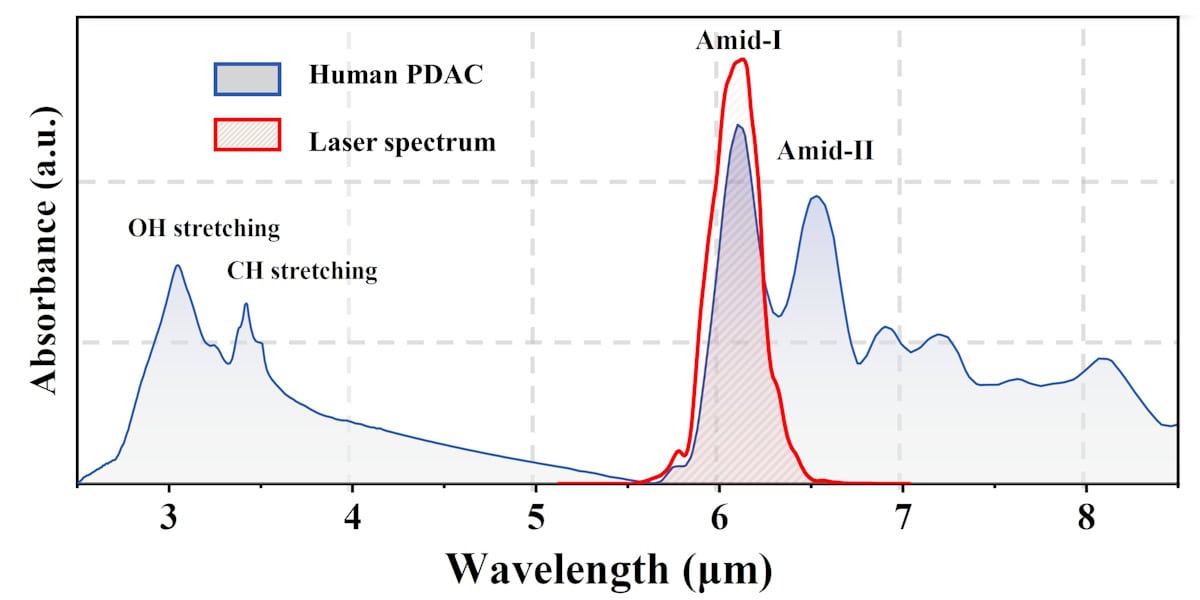
The technique exploits the fact that PDAC tissue contains a large amount of collagen compared with healthy pancreatic tissue. Amide-I collagen fibres exhibit a strong absorption peak at 6.1 µm, thus the researchers surmised that tuning the treatment laser to this resonant wavelength could enable efficient tumour ablation with minimal collateral thermal damage. As such, they designed a femtosecond pulsed laser that can deliver 6.1 µm pulses with a power of more than 1 W.

FTIR spectra of PDAC and the laser
Resonant wavelength Fourier-transform infrared spectra of PDAC (blue) and the laser (red). (Courtesy: Houkun Liang, Sichuan University)

“We developed a mid-infrared femtosecond laser system for the selective tissue ablation experiment,” says team leader Houkun Liang. “The system is tunable in the wavelength range of 5 to 11 µm, aligning with various molecular fingerprint absorption peaks such as amide proteins, cholesteryl ester, hydroxyapatite and so on.”

Liang and colleagues first examined the ablation efficiency of three different laser wavelengths on two types of pancreatic cancer cells. Compared with non-resonant wavelengths of 1 and 3 µm, the collagen-resonant 6.1 µm laser was far more effective in killing pancreatic cancer cells, reducing cell viability to ranges of 0.27–0.32 and 0.37–0.38, at 0 and 24 h, respectively.

The team observed similar results in experiments on ectopic PDAC tumours cultured on the backs of mice. Irradiation at 6.1 µm led to five to 10 times deeper tumour ablation than seen for the non-resonant wavelengths (despite using a laser power of 5 W for 1 µm ablation and just 500 mW for 6.1 and 3 µm), indicating that 6.1 µm is the optimal wavelength for PDAC ablation surgery.

To validate the feasibility and safety of 6.1 µm laser irradiation, the team used the technique to treat PDAC tumours on live mice. Nine days after ablation, the tumour growth rate in treated mice was significantly suppressed, with an average tumour volume of 35.3 mm3. In contrast, tumour volume in a control group of untreated mice reached an average of 292.7 mm3, roughly eight times the size of the ablated tumours. No adverse symptoms were observed following the treatment.

Clinical potential

The researchers also used 6.1 µm laser irradiation to ablate pancreatic tissue samples (including normal tissue and PDAC) from 13 patients undergoing surgical resection. They used a laser power of 1 W and four scanning speeds (0.5, 1, 2 and 3 mm/s) with 10 ablation passes, examining 20 to 40 samples for each parameter.

At the slower scanning speeds, excessive energy accumulation resulted in comparable ablation depths. At speeds of 2 or 3 mm/s, however, the average ablation depths in PDAC samples were 2.30 and 2.57 times greater than in normal pancreatic tissue, respectively, demonstrating the sought-after selective ablation. At 3 mm/s, for example, the ablation depth in tumour was 1659.09±405.97 µm, compared with 702.5±298.32 µm in normal pancreas.

The findings show that by carefully controlling the laser power, scanning speed and number of passes, near-complete ablation of PDACs can be achieved, with minimal damage to surrounding healthy tissues.

To further investigate the clinical potential of this technique, the researchers developed an anti-resonant hollow-core fibre (AR-HCF) that can deliver high-power 6.1 µm laser pulses deep inside the human body. The fibre has a core diameter of approximately 113 µm and low bending losses at radii under 10 cm. The researchers used the AR-HCF to perform 6.1 µm laser ablation of PDAC and normal pancreas samples. The ablation depth in PDAC was greater than in normal pancreas, confirming the selective ablation properties.

“We are working together with a company to make a medical-grade fibre system to deliver the mid-infrared femtosecond laser. It consists of AR-HCF to transmit mid-infrared femtosecond pulses, a puncture needle and a fibre lens to focus the light and prevent liquid tissue getting into the fibre,” explains Liang. “We are also making efforts to integrate an imaging unit into the fibre delivery system, which will enable real-time monitoring and precise surgical guidance.”

Next, the researchers aim to further optimize the laser parameters and delivery systems to improve ablation efficiency and stability. They also plan to explore the applicability of selective laser ablation to other tumour types with distinct molecular signatures, and to conduct larger-scale animal studies to verify long-term safety and therapeutic outcomes.

“Before this technology can be used for clinical applications, highly comprehensive biological safety assessments are necessary,” Liang emphasizes. “Designing well-structured clinical trials to assess efficacy and risks, as well as navigating regulatory and ethical approvals, will be critical steps toward translation. There is a long way to go.”

The post Resonant laser ablation selectively destroys pancreatic tumours appeared first on Physics World.

  •  

Le Tour de France fait son retour en Haute-Savoie

Le Tour de France fait son retour en Haute-Savoie. Un coup de projecteur sur les routes de Haute-Savoie. Le directeur du Tour de France, Christian Prud'homme, est heureux de ce futur tracé. Une montée ultra pentue est attendue après deux semaines de course, ce qui pourrait faire basculer la course au classement général.

  •  
❌